
Grant Writing for Artists: Preparing a Strong Application
To prepare a strong artist grant application, first confirm eligibility, requirements, and assessment criteria; then define the project’s goals, activities, audience, timing, and funding need, and make the narrative, budget, timeline, and supporting evidence describe the same project facts. Strength is opportunity-specific: clear, specific, feasible, and internally consistent applications are easier to assess, but no formula guarantees funding.
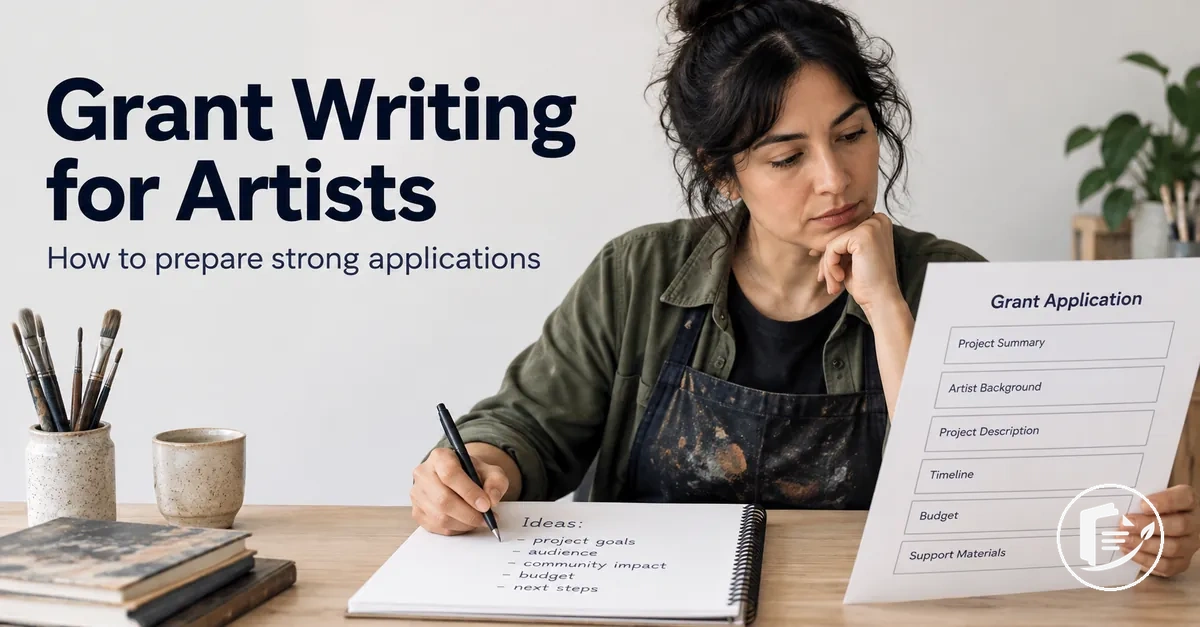
Artist grant application preparation map
Use these four stages to move from a funding opportunity to a coherent submission. Each stage answers a different preparation question, and the final application should satisfy all four for the specific grant.
- Check fit and requirementsConfirm eligibility, deadline, required format, attachments, word or character limits where specified, priorities, and assessment criteria.
- Define the project factsSet out what will happen, why it matters, who is involved or affected, when it will occur, and what funding or resources are needed.
- Build one consistent caseMake the proposal or responses, artistic evidence, budget, timeline, CV, work samples, and other required materials support the same project scope and claims.
- Review before submissionCorrect non-compliance, missing material, conflicting dates or figures, unsupported claims, and unclear wording before lower-impact polishing.
Readiness is not a funding guarantee. The funder’s current rules and criteria determine what must be submitted and how the application is assessed.
Table of Contents
What Grant Writing Involves for Artists
Artist grant writing is the work of presenting an artistic project, its purpose, supporting evidence, and funding need in the form requested by a grant maker.
Within an artist grant application, the writing develops the case for support by explaining what is proposed and why the project is relevant to the funding opportunity.
It is the writing component of the broader application process rather than the entire grant application.
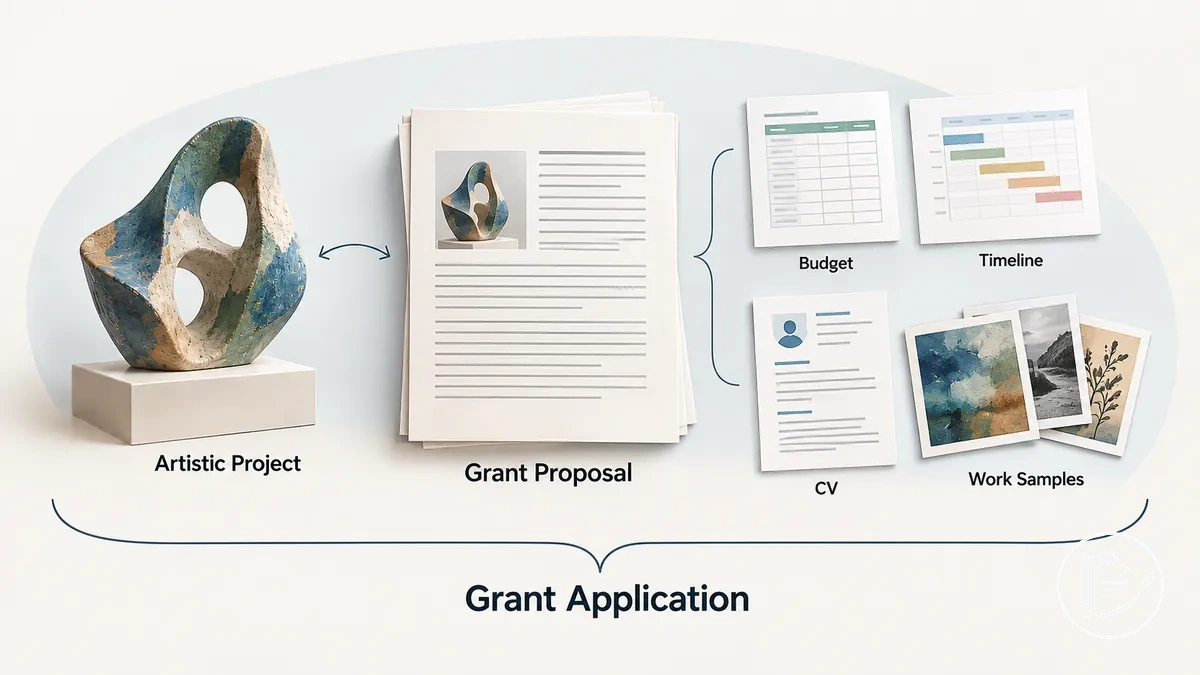
A grant proposal or other written responses may sit alongside required materials such as eligibility information, forms, a budget, timeline, work samples, or CV, depending on the funder requirements for that opportunity.
Each component serves a different informational function, while the full application brings those components together for assessment.
Because the required materials are set by the particular grant maker and funding opportunity, the exact application package can differ.
Understanding this boundary makes it easier to distinguish the grant proposal from its role within the full application.
How a Grant Proposal Fits Within the Full Application
A grant proposal forms one part of the full application: it carries the project narrative that explains the artistic project, its goals, and the funding request, while the full application is the complete set of materials required by the funder.
The proposal therefore presents the project-focused case rather than representing the entire submission package.
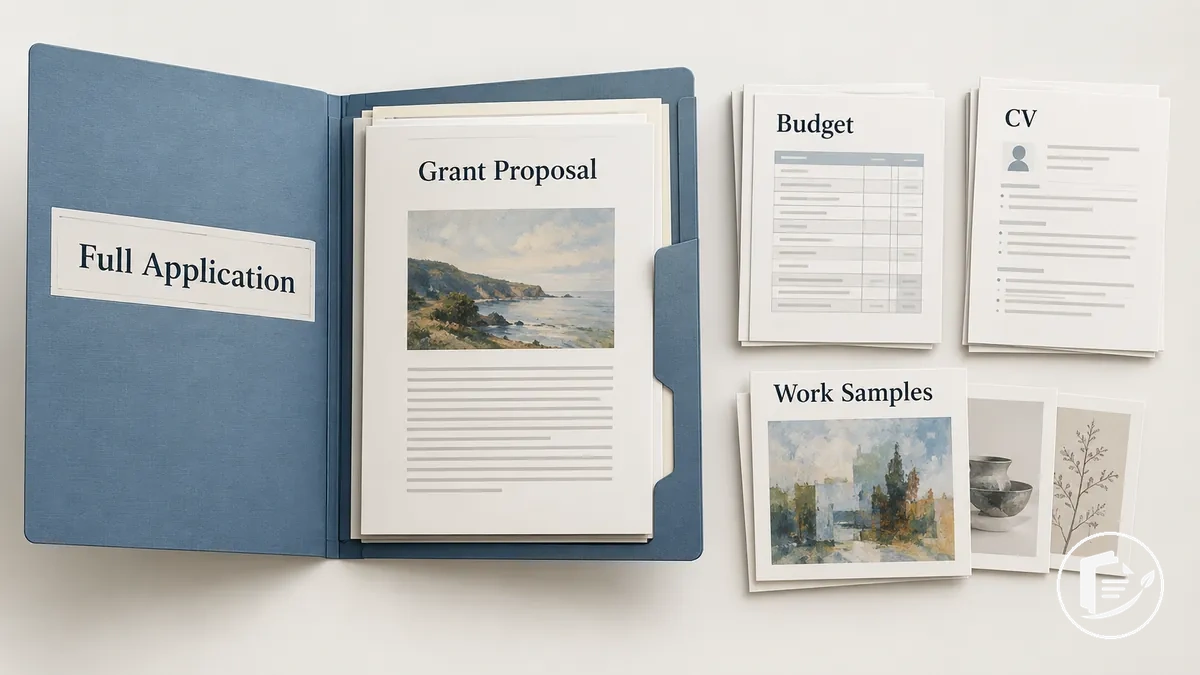
The grant proposal must remain consistent with supporting materials such as forms, a budget, CV, work samples, and other administrative, financial, biographical, or artistic evidence requested for that opportunity.
Some funders use application questions or short-form narrative fields instead of requiring a standalone proposal, so the proposal format depends on the funder requirements.
In either format, consistency means that the project narrative and supporting evidence describe the same artistic project without conflicting information.
For deeper guidance on the narrative itself, see how to write an art grant proposal.
What Makes an Artist Grant Application Strong
A strong artist grant application is clear, specific, aligned with the funding opportunity, feasible, supported by relevant evidence, and consistent across its materials.
These qualities make the artistic project easier to assess against the funder's priorities and assessment criteria without implying that any single formula determines the funding decision.
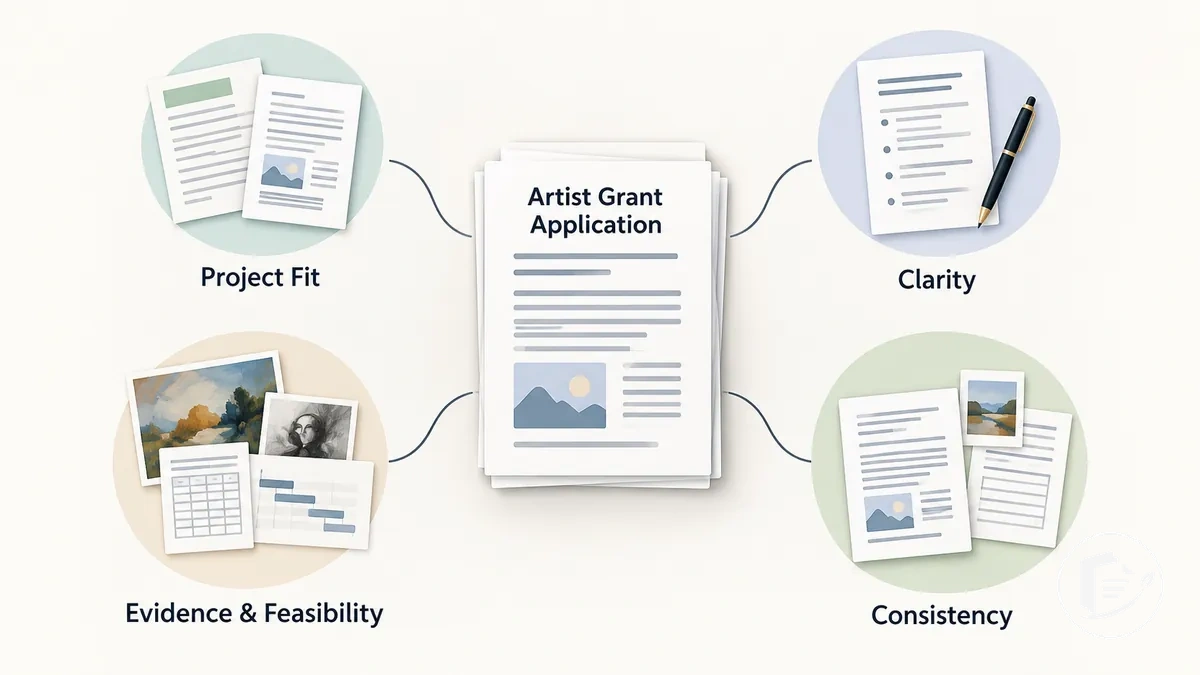
The main strength signals are project fit, communication quality, evidence and feasibility, and consistency.
Project fit makes the relationship between the project, the funding opportunity, its priorities, eligibility conditions, and assessment criteria explicit; clarity and specificity make the project goals easier to understand; relevant evidence supports important claims about the project and the artist's capacity; feasibility connects the proposed scope with the budget, timeline, and available resources; and consistency keeps application responses and supporting materials aligned.
- Project fit: The artistic project should clearly match the funding opportunity's stated priorities, eligibility conditions, and assessment criteria. Explicit alignment helps reviewers understand why the project belongs within that particular grant program.
- Clarity and specificity: Concise writing should identify what the artist proposes to do, why it matters in the application's context, and what the requested support will enable. Concrete project goals make the proposal more assessable than broad or ambiguous claims.
- Evidence and feasibility: Relevant experience, work samples, project details, or other supporting evidence should substantiate important claims, while the proposed activities, budget, timeline, and available resources should support a credible plan for carrying out the project. Together, these conditions strengthen the case that the proposed work is supported and practicable within the stated project scope.
- Consistency: Application responses, the budget, timeline, work samples, and other supporting materials should describe the same project without material contradictions. Consistency supports credibility because reviewers can follow one coherent account across the application.
Funders may give these qualities different emphasis according to their program priorities and assessment criteria, so a strong grant application responds to the specific funding opportunity rather than assuming a fixed weighting.
Understanding how artist grant applications are reviewed clarifies how these qualities can operate within formal assessment.
Application strength is therefore criteria-based and opportunity-specific rather than the result of a universal formula.
Alignment Between the Project and the Funding Opportunity
Project-to-funding-opportunity alignment means that the artistic project and applicant correspond to the opportunity's stated purpose, eligibility boundaries, priorities, and assessment criteria.
Project evidence should show that correspondence through the project's goals, activities, audience, and other relevant details, rather than through superficial keyword matching.
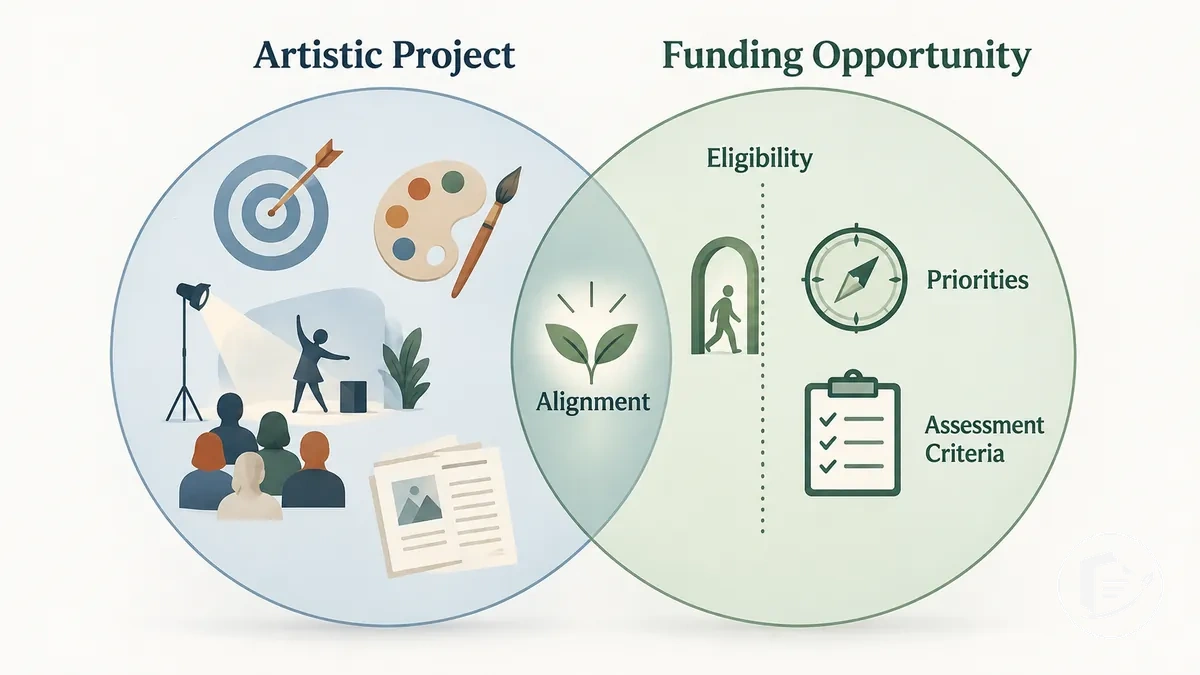
The main alignment dimensions connect the funding opportunity's requirements with observable evidence from the project:
- Purpose and project goals: The artistic project's goals and activities should address the purpose of the funding opportunity, making the basis for relevance explicit.
- Eligibility: The applicant and project must meet the stated eligibility conditions to pass the threshold for consideration; meeting that threshold does not by itself establish stronger alignment.
- Priorities: Project evidence should show how relevant activities, audiences, or intended outcomes correspond to the funder's stated priorities, demonstrating genuine fit rather than keyword overlap.
- Assessment criteria: The application should connect relevant project evidence to the published criteria so the project's fit can be assessed within that opportunity's specific context.
Eligibility is a threshold condition: it determines whether the applicant and artistic project can be considered under the stated rules, while alignment describes how closely the project addresses the opportunity's purpose, priorities, and assessment criteria.
Because the degree of fit depends on the particular grant opportunity, the application should frame existing project evidence honestly rather than reshape the project merely to echo funding language.
Comparing opportunities and choosing a grant that fits your project is a separate task once this eligibility-versus-alignment distinction is clear.
Clear, Concise, and Specific Writing
Effective grant application writing uses clear, concise, and specific language so reviewers can understand the artistic project quickly.
Direct wording should identify what the project proposes without jargon, decorative language, or inflated claims that obscure its meaning.
Clear writing makes the project goals and purpose easy to understand, while concise writing uses only the wording needed to communicate the relevant information.
Specific writing identifies concrete project facts, such as the activities, audience, timing, or intended purpose, instead of relying on broad claims.
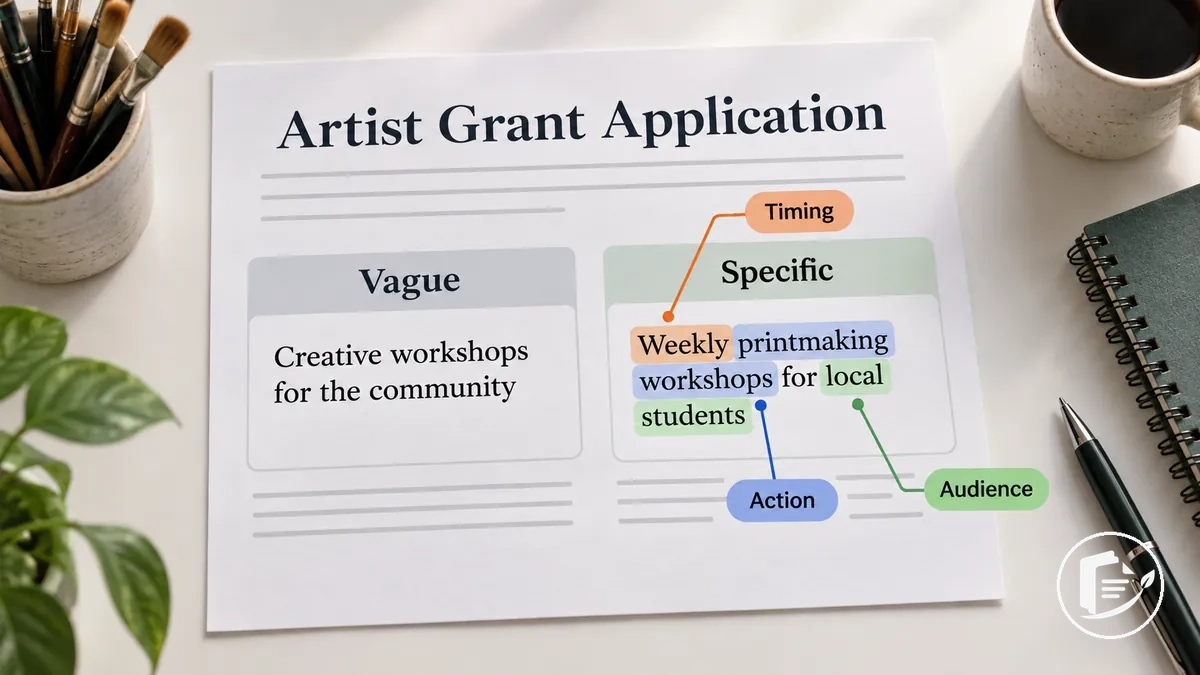
For example, “We will run creative workshops for the community” is vague because the activity and audience remain broad; “We will run weekly printmaking workshops for local secondary-school students during the project period” is more specific because it identifies the activity, audience, and timing without claiming an unsupported outcome.
Vague, inflated, or jargon-heavy statements are among the common artist grant writing mistakes that can make the proposed work harder to interpret.
Concrete details make the grant application easier to understand and assess, but clear wording does not guarantee funding.
Credible Goals, Evidence, and Project Feasibility
Artistic project credibility comes from project goals that are understandable, evidence that supports what is proposed, and feasibility conditions indicating that the project is realistically deliverable.
These three dimensions reinforce one another by connecting the project's purpose with supporting information and the practical conditions needed to carry it out.
- Project goals: Goals identify the artistic project's intended results and connect them to the proposed activities, giving the project a clear purpose against which the plan can be understood.
- Evidence: Supporting evidence, such as relevant experience, work samples, or other supporting materials when requested, can demonstrate that the proposal is grounded in the artist's or team's capacity and prior work.
- Feasibility: Appropriate timing, resources, budget, experience, and collaborators can indicate whether the proposed activities are realistically deliverable under the conditions described in the grant application.
The evidence used to support feasibility depends on the artistic project and the funding opportunity, so no single combination of experience, budget information, collaborators, or other materials applies to every grant.
For example, a project goal becomes more credible when relevant experience supports the proposed activity and the stated timing and resources are consistent with carrying it out.
Together, these conditions support an assessment of project credibility without proving that the project will succeed or receive funding.
Consistency Across the Full Application
Application consistency means that the project description, budget, timeline, goals, dates, figures, and supporting materials agree on the substantive facts of the same project.
Consistent components support credibility because related claims and evidence describe a coherent project scope rather than conflicting versions of what is proposed.
Substantive conflicts in dates, figures, scope, or claims can undermine credibility, but they do not determine the funding outcome automatically.
Prepare the Application Before You Start Writing
Grant application preparation should resolve the grant guidelines, requirements, core facts of the artistic project, available supporting evidence, and practical constraints before drafting begins.
Clarifying these prerequisites reduces the risk of later omissions or contradictions and establishes what the application needs to communicate.
A sensible preparation sequence moves from the funder's requirements to the project definition, then to the evidence and constraints that support drafting readiness:
- Review the grant guidelines and requirements: Identify the relevant deadlines, required formats, assessment criteria, and other funder instructions that affect what the application must address.
- Define the artistic project: Clarify the project goals, intended activities, audience, timing, and funding need so the core project facts are established before they are described across the application.
- Gather supporting evidence and identify constraints: Determine which available evidence supports the proposed project and identify relevant resources or other practical constraints that affect what can realistically be presented.
- Confirm drafting readiness: Check that the resolved project facts, available evidence, and known requirements provide a consistent basis for beginning the written application.
The exact planning order can vary because grant guidelines and required supporting evidence differ by funding opportunity.
Some project decisions may therefore need to be resolved alongside particular funder requirements rather than in a fixed sequence.
The stable preparation goal is to clarify the requirements and material project facts that affect the application before drafting them into responses.
Read the Guidelines and Identify the Required Information
The current grant guidelines determine the required information, eligibility conditions, deadline, format, word limit where specified, attachments, and assessment criteria that apply to the application.
Before drafting, classify the current guidelines by requirement status and identify the response or evidence associated with each applicable condition.
The main requirement classes to scan are:
- Eligibility: Identify the applicant or project conditions that the funder states must be met and the information needed to establish eligibility.
- Deadline: Confirm the submission date and any time or time-zone condition stated for that funding opportunity.
- Format and length: Record required response formats and any stated word limit, character limit, or other length constraint without assuming a standard limit.
- Required information: Identify each question, project detail, or other response the application instructions require.
- Attachments: Gather only the supporting materials or evidence required or permitted by the funder's instructions, noting which are mandatory and which are optional.
- Assessment criteria: Identify the published criteria that indicate which aspects of the application the funder intends to assess.
For example, if the guidelines specify a word limit for a project response, that condition determines the maximum length that should be prepared for that particular field rather than establishing a general limit for grant writing.
The wider artist grant application process and requirements covers the broader procedural and eligibility context beyond this pre-drafting review of the guidelines.
Define the Project, Goals, Audience, Timing, and Funding Need
Before drafting, define the artistic project through its core facts: what will happen, why it matters, who is involved or affected, when the activities will occur, and what funding is needed.
Making these project attributes explicit gives later application components a stable factual basis.
The planning questions below capture the project's factual core without turning the exercise into a full proposal draft:
- Project: What artistic project is being proposed, and which activities describe what will actually happen?
- Purpose and goals: What is the project purpose, and what goals or intended results should the activities support?
- People and audience: Who will participate, collaborate, benefit, or form the relevant audience, where those roles matter to the project?
- Timing: When will the main activities occur, and what timing conditions affect the project scope or delivery?
- Funding need: What resources are needed to carry out the proposed activities, and which part of that need is expected to be supported by the grant?
Concrete answers help the narrative, budget, timing information, and other supporting materials describe the same artistic project rather than conflicting versions of it.
The exact audience, resources, intended results, and funding structure can vary by project and funding opportunity, so the purpose of this planning is consistency rather than forcing every application into one project model.
Once the factual core is clear, those facts can be represented consistently in the later application components.
How the Main Application Components Work Together
Artist grant application components work as coordinated evidence for the same artistic project, with each component serving a different informational function while supporting a coherent project case.
The project narrative, artistic evidence, budget, timeline, and supporting materials should therefore describe compatible project facts rather than operate as isolated documents.
The main cross-component relationships concern consistency between what the application claims and what its other materials show.
These relationships help keep the project scope, proposed activities, evidence, resources, and timing aligned without assuming that every funder requires the same set of components:
- Project narrative and artistic evidence: The artistic evidence should support or corroborate relevant claims about the artist, proposed work, experience, or artistic context where those claims are part of the application.
- Project narrative, budget, and timeline: The activities and project scope described in the project narrative should match the resources represented in the budget and the period available in the timeline.
- Goals and supporting materials: Supporting materials should reinforce relevant statements about the project's goals, participants, collaborators, or feasibility when those materials are requested or provided.
- Application responses and project facts: Separate application responses should remain consistent about material facts such as activities, project scope, timing, and funding need rather than presenting conflicting versions of the same artistic project.
The exact application components and the way a funder evaluates them depend on the requirements of the particular funding opportunity.
The stable principle is that required materials should perform their distinct functions while remaining consistent with the same project facts.
Project Description, Goals, and Application Responses
The project description, project goals, and application responses perform different narrative functions while referring to the same artistic project.
The way a funder separates these elements can vary, so the application should adapt to and answer each question directly without imposing a universal narrative order.
Artist Statement, CV, and Work Samples
Artist evidence materials serve distinct functions within an application: the artist statement contextualizes the artistic practice, the CV documents relevant experience, and work samples demonstrate the artistic work itself.
Together, when requested, these materials can provide different forms of evidence about the applicant and the artistic project.
The three materials can reinforce applicant credibility or project relevance when their information remains consistent with the same artistic practice and project context.
Their primary evidence functions are:
- Artist statement: Contextualizes the artistic practice, its ideas or direction, and relevant project context, supporting an understanding of how the proposed artistic project relates to the applicant's practice.
- CV: Documents relevant experience through the applicant's professional record, such as previous projects or exhibitions where applicable, and should remain consistent with material experience described elsewhere in the application.
- Work samples: Demonstrate the applicant's actual artistic work and can provide evidence relevant to the practice or proposed project when the submitted samples have that relationship.
Which of these materials is required, and how each is assessed, depends on the funder's application requirements.
When requested together, consistency among the artist statement, CV, work samples, and application responses allows the materials to reinforce the same applicant and project context without requiring each item to provide the same evidence.
Budget, Timeline, and Supporting Materials
The budget, timeline, and supporting materials are project feasibility materials that show whether the artistic project's scope is supported by appropriate resources, workable timing, and relevant evidence.
Together, they help establish whether the activities described in the application are consistent with the practical conditions and documentation presented for the project.
Each component represents a different aspect of project scope and feasibility, so its information should align with the activities and claims in the project description:
- Budget: Shows the costs, resources, and funding need associated with the proposed activities, allowing those expenses to be compared with the stated project scope.
- Timeline: Maps activities to relevant dates, timing, and sequence, showing whether the proposed work fits within the period described for the project.
- Supporting materials: Provide supporting evidence or corroboration where required or permitted by the funder, and should remain consistent with the project details or claims they are intended to support.
For example, if the project description includes an activity but the budget provides no relevant resources for it or the timeline provides no workable time for it, the application presents a cross-component inconsistency that may raise questions about feasibility.
Required formats, costs, dates, and supporting materials depend on the particular project and the funder's requirements.
Consistency across these components means that the project's activities, resources, timing, and supporting evidence describe a compatible practical scope.
Review the Application for Coherence and Readiness
Application review is the refinement of an already drafted application, not a new writing phase.
The review should verify compliance with the funder's requirements and confirm that the application is complete, coherent, clear, and ready for submission.
Start with high-impact checks that can reveal non-compliance, unanswered requirements, or contradictions, then move to clarity and readability.
The checklist tests whether the current draft satisfies required conditions, contains the necessary materials, and presents consistent project information.
An artist grant application checklist can support this final verification before submission.
- Verify compliance: Compare the current draft with the applicable requirements, including eligibility conditions, deadline, format, and any required fields, and correct any identified mismatch.
- Check completeness: Confirm that required prompts are answered and identify any missing materials or attachments required for the application.
- Check coherence: Compare the project scope, goals, activities, dates, and figures across components, and correct conflicting dates or figures or other material contradictions.
- Check supporting evidence: Identify unsupported claims that require evidence or qualification and confirm that relevant supporting materials correspond to the claims they are intended to support.
- Check clarity: Review application responses for ambiguous wording, unnecessary repetition, and readability problems that could make the project difficult to understand.
- Confirm readiness: Recheck corrected items against the funder's requirements and confirm that the submitted components are internally consistent and complete for that opportunity.
Non-compliance, missing required material, and substantive contradictions should be corrected before lower-impact polishing issues because they affect whether the application follows its stated requirements or presents a coherent project case.
Clarity edits can then refine readability without reopening the proposal as a new draft.
A final review improves readiness but does not guarantee funding; its purpose is to confirm compliance, completeness, and internal coherence before submission.