
Common Artist Grant Writing Mistakes
The most consequential artist grant-writing mistakes are unclear project language, unsupported claims, and internal inconsistencies between goals, activities, outcomes, dates, roles, or other repeated details. Correct them by making the project action and intended result explicit, adding only the concrete detail needed to support each claim, and checking that repeated project facts and logical connections agree across the application. These writing errors can weaken reviewer comprehension, but they do not by themselves determine whether an application is funded.

Grant-writing diagnostic: identify the problem before revising
Match the reviewer-facing signal to the writing issue, then make the smallest correction that restores meaning, support, or coherence.
Interpretation boundary: these signals identify what to check in the writing; they do not prove why an application was rejected or guarantee funding after revision.
A reviewer should be able to identify what the artist will do, why the proposal says it matters, and how the stated activities connect to the intended outcomes without having to supply missing project facts.
This page focuses on how the project is expressed in writing rather than on eligibility, budgeting, work samples, funder fit, or submission mechanics.
Table of Contents
Clarity Mistakes That Obscure the Art Project
Clarity mistakes can obscure an otherwise sound art project by increasing the interpretation effort required to understand what the artist means.
Dense wording, overloaded sentence structure, or assumed knowledge can make the project's purpose and activity harder for a reviewer to recover accurately.
The problem is the accessibility of the explanation, not the artistic complexity of the project itself.
The image below illustrates how paragraph-level editing can make the same project idea easier to follow without changing its substance.

Clearer does not mean simpler.
A sentence such as “The installation activates a liminal spatial dialogue through participatory intervention” may preserve a complex artistic idea, but it can require unnecessary interpretation when key terms are left unexplained.
Clearer wording would retain the intended concept while stating what the artist will create, how participants will engage with it, and any discipline-specific meaning the reviewer cannot safely be assumed to know.
The practical test is readability: the reviewer should be able to follow the art project without unnecessary decoding while its artistic complexity remains intact.
Vague or Generic Language
Vague language is a writing error when a claim leaves a project detail that matters to its meaning for the reviewer to infer.
Depending on the claim, the missing attribute may be the proposed activity, audience, scale, timing, or intended outcome; broad wording is not inherently wrong when greater specificity would not change the relevant meaning.
The image below identifies which project detail a vague sentence leaves for the reviewer to infer.
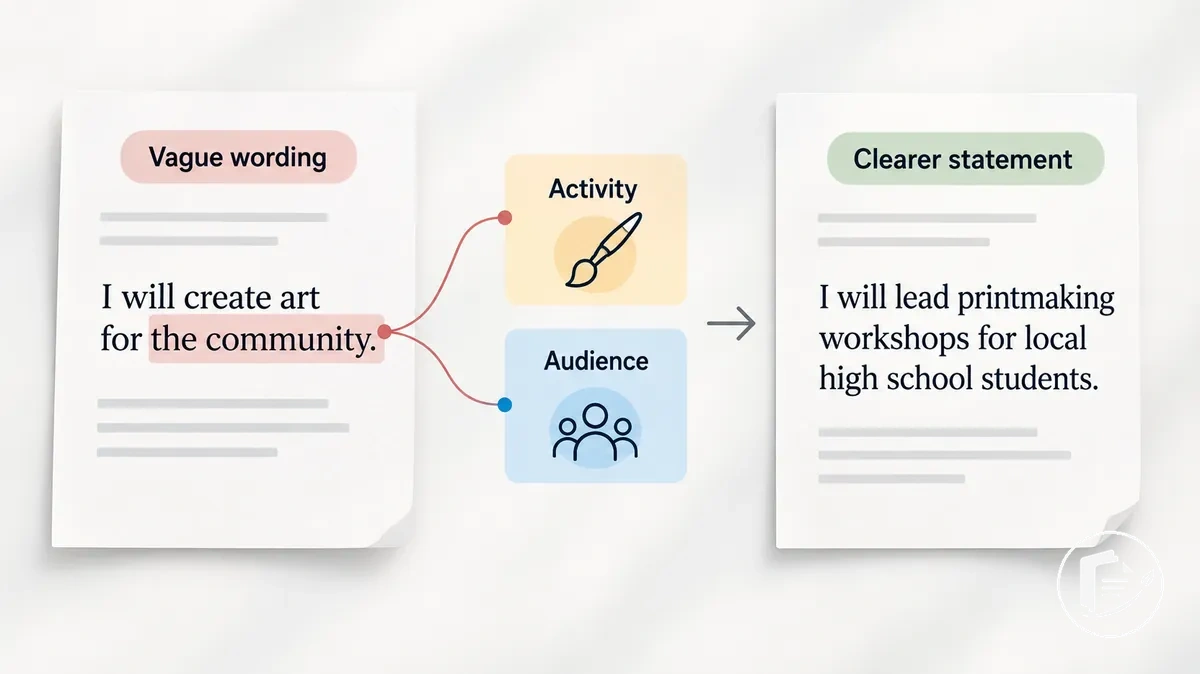
Generic: “The project will engage the community through a meaningful arts program.” Specific: “The project will invite local residents to participate in artist-led printmaking workshops.” The generic claim leaves the activity and audience unspecified, while the specific version supplies those attributes so the reviewer does not have to infer what participation involves or who will take part.
Specificity should add the project detail needed to interpret the claim, rather than detail that does not affect its meaning.
Jargon, Clichés, Buzzwords, and Acronyms
Jargon and other specialist language become a clarity problem when a term is necessary to understand the artistic project but its meaning is not recoverable from context.
A discipline-specific term can preserve precision when reviewer familiarity can reasonably be assumed; otherwise, a short explanation or plain-language gloss can reduce avoidable decoding work.
The image below illustrates how a brief explanation can retain specialist meaning while making the terminology accessible.
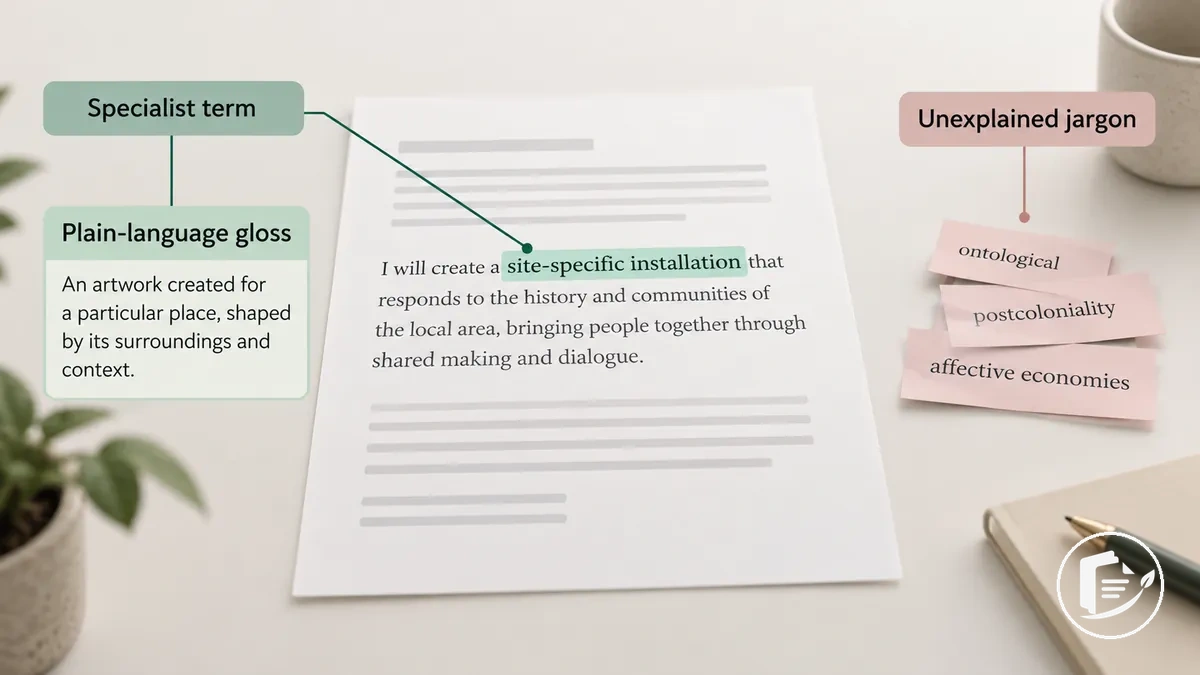
Necessary terminology: “The work uses chiaroscuro, a strong contrast between light and dark, to shape the figures.” Here, the discipline-specific term remains because it conveys a precise artistic idea, while the explanation supplies meaning for a reviewer who may not know it.
By contrast, an unexplained acronym, jargon, cliché, or promotional buzzword that adds little usable meaning may create unnecessary decoding work.
Define or replace specialist language only when its meaning cannot safely be inferred from the surrounding context.
Tentative or Promotional Language
Tentative language can understate a claim when the available project detail supports greater confidence, while promotional language can overstate novelty, importance, or likely impact beyond the available evidence.
Neither problem is defined by a single word; the relevant condition is whether the wording is proportionate to its support.
The image below illustrates how claim strength can shift from unnecessary uncertainty to unsupported overstatement.
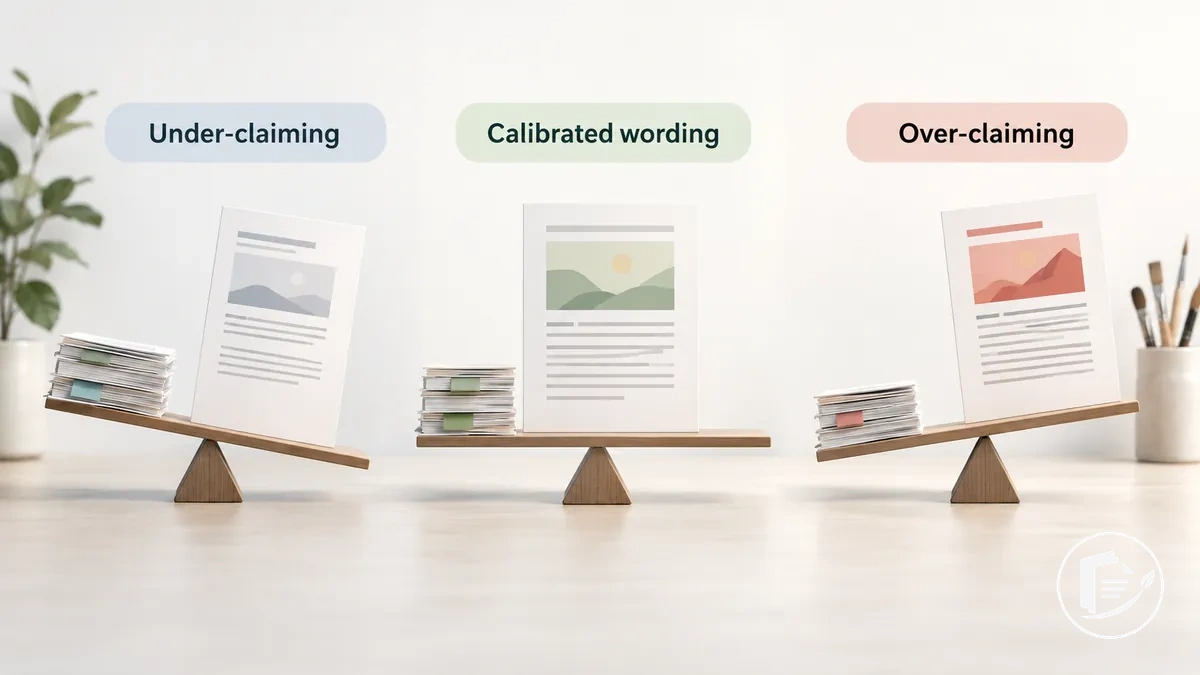
The three examples compare the relationship between available support and wording strength, moving from under-claiming through calibrated wording to over-claiming.
- Unsupported uncertainty: “The project might perhaps help participants explore new creative approaches,” even though the application specifies the planned activity and intended outcome.
- Calibrated statement: “The project is intended to help participants explore new creative approaches through the planned activity,” expressing the intended impact without presenting it as certain.
- Unsupported promotional claim: “The project will deliver a groundbreaking creative impact,” when no evidence or project detail establishes that level of novelty or impact.
Claim strength should match the evidence and project detail available to support it.
Confidence is appropriate where the application can state what the project will do, while uncertainty can be expressed precisely when an outcome is intended, expected, or genuinely conditional.
Promotional language becomes an overstatement when its certainty or emphasis exceeds that support, just as excessive tentative language can make a supported claim sound less definite than necessary.
The local objective is calibrated wording: state the claim as strongly as its support permits without converting an intended impact into a guaranteed result.
Failing to Connect Prior Research to Research Questions and Methodological Choices
For an artist grant application with a research component, prior research can clarify the question being investigated and explain why a particular method is appropriate to that project.
Relevant findings can narrow the question by identifying the population, context, material, or condition that still needs investigation, while prior methods help the applicant explain method fit rather than simply name a technique.
A literature review research question is most useful here when it helps define the unresolved issue the artistic research will address; it should remain connected to the proposed project rather than becoming a separate academic summary.
A recurring measurement or method limitation can also show what the proposed approach needs to capture differently.
Prior work therefore provides criteria for the project’s research choices; it does not automatically determine the question or method.
The previous work identifies where the unresolved issue sits.
The question follows from the gap rather than from a generic topic.
Prior methods are evidence to assess for fit, not templates to copy.
In a grant application, make this connection explicit so prior research functions as project rationale rather than as background detached from the proposed artistic work.
Specificity Mistakes That Leave Claims Unsupported
Specificity mistakes occur when an important claim lacks enough relevant project detail for a reviewer to understand what is proposed or why the claim has support.
The required specificity depends on the claim: supporting information should anchor the claim with evidence or concrete detail that materially improves interpretation.
Credibility therefore depends on sufficient and relevant support, not on maximum detail or false precision.
The claim gives the reviewer little project detail with which to interpret the asserted impact.
The activity gives the claim a concrete basis while the intended impact remains appropriately qualified.
More detail is not automatically more useful when it does not change how the claim is interpreted.
Sufficient specificity means including the project detail that materially supports the particular claim, rather than requiring an exact metric or exhaustive description.
Claims Without Concrete Project Details
A claim is unsupported when it asks the reviewer to accept importance, reach, quality, need, or impact without the project fact required to interpret that claim.
Relevant support may come from a concrete activity, participant group, output, location, or delivery condition, depending on what the assertion says.
Unsupported: “The project will reach a broad community” states reach without identifying the participant or location that would give the claim a factual basis.
Grounded: “The project is intended for local residents participating in artist-led workshops at the community arts centre” supplies the participant, activity, and location needed to interpret the intended reach without inventing a metric.
These project facts support interpretation of the claim, but they do not establish its eventual impact or guarantee reviewer confidence.
The detail needed for support therefore depends on the specific claim and the factual attribute relevant to it.
Goals and Outcomes That Are Not Clearly Defined
A goal or outcome is unclear when its intended result cannot be identified from the wording, whether that result involves completion, participation, learning, access, or artistic development.
Specificity does not require every outcome to be numeric. A qualitative intended change can be clear when the relevant condition or result is described precisely.
The wording does not identify what development means in this project.
The intended result is clear through development and completion.
The result is defined through access and participation without inventing a numeric target.
Open-ended creative work can therefore retain uncertainty while still stating a sufficiently clear goal or outcome.
Assuming the Reviewer Already Knows the Artist or Project
Context can remain brief when no further background changes the interpretation of the current proposal.
The aim is selective context that supports understanding, not a full biography or exhaustive history.
Narrative Mistakes That Break Internal Coherence
Narrative coherence depends on the application's statements remaining compatible and logically connected across goals, activities, outcomes, and application responses.
A coherent narrative lets the reviewer trace how what the artist intends to do relates to why the project matters and what it is expected to produce or change.
Smooth prose alone does not create coherence when those relationships conflict or remain unclear.
The stated purpose depends on participant involvement.
The activity does not match the participatory mechanism described in the goal.
The outcome is left without a traceable pathway from the stated activity.
Diagnostic standard: repeated project details must remain compatible, and the reviewer should be able to trace the reasoning from goal to activity to outcome without repairing contradictions on the applicant’s behalf.
A reviewer should be able to follow how the goals connect to the activities and outcomes without having to reconcile contradictory statements or infer a missing logical connection; unresolved conflicts can weaken confidence in the proposal's internal logic.
Narrative coherence is a writing-specific issue within the application, while eligibility, funder fit, evidence requirements, and other factors belong to the broader question of why grant applications get rejected.
Goals, Activities, and Outcomes That Do Not Connect
A goal-activity-outcome connection breaks when the project action does not plausibly contribute to the intended result, or when the relationship is left unstated.
The goal, activity, and outcome should form a traceable connection in which the activity addresses the goal and the outcome describes the intended result under relevant project conditions.
Connected chain: in an illustrative printmaking project, a goal of increasing local participation connects to the activity of artist-led community printmaking workshops and an intended outcome of participant engagement with printmaking; the project action therefore has an explicit and plausible connection to the intended result.
Mismatched chain: for the same illustrative project, pairing that participation goal with independently producing a studio artwork while retaining increased local participation as the outcome leaves the connection between the project action and intended result unstated.
The diagnostic condition is plausibility: the stated activity should provide a reasonable pathway toward the outcome rather than merely appearing beside it in the application.
A coherent connection can show how an activity is intended to contribute to an outcome, but it does not establish that the activity will produce that result.
Inconsistent Details Across Application Responses
Repeated project details become a coherence error when one application response assigns a date, participant group, location, role, activity, or output that conflicts with the value or description given elsewhere.
Consistency requires the same project attribute to remain compatible across responses unless the application clearly explains why the detail changes.
- Entity
- The same exhibition.
- Attribute
- Opening date.
- Response A
- September.
- Response B
- November, with no explanation for the change.
- Interpretation
- The values conflict. The mismatch can change how the reviewer understands project timing and, depending on the surrounding plan, feasibility.
- Same rule applies to
- Participant groups, locations, roles, activities, outputs, and other repeated project attributes.
The local error is the unresolved mismatch between repeated project details, rather than the broader task of verifying the entire application before submission.
Repetition That Replaces New Information
Repetition becomes an error when a later mention repeats the same claim without adding new information through evidence, context, consequence, or connection.
Purposeful reinforcement can support coherence when a central term needs to recur, but the later mention should advance its meaning rather than merely restate it.
The second sentence restates the claim without adding a fact, relationship, consequence, or necessary context.
The repeated concept now advances through new context and a connection between the access claim and the proposed activity.
Information gain, rather than synonym substitution, is the test for useful progression.
How to Diagnose a Weak Grant-Writing Passage
Diagnosing a weak grant-writing passage means identifying its dominant writing problem before deciding what to revise.
The diagnostic goal is to determine whether the main point is recoverable without an unsupported assumption, whether each sentence function contributes useful information, and whether the passage maintains coherence from one idea to the next.
An observable signal can indicate where to check, but it should not be treated as a definitive cause of the weakness.
Start with the intended meaning and identify the observable signal that makes the passage difficult to interpret.
Then separate three possible sources of weakness so the interpretation points toward the appropriate correction rather than attributing every symptom to the same problem:
- Meaning clarity: check whether the main point can be recovered without requiring the reviewer to supply a missing assumption; if not, the likely problem is missing or unclear information.
- Sentence contribution: check whether each sentence function adds relevant evidence, explanation, context, or connection; repeated content without a new informational role suggests redundancy.
- Logical followability: check whether the reasoning connects from one statement to the next; an unexplained shift or conflict suggests a coherence problem that needs to be distinguished from unclear wording.
For example, suppose a passage states that a project will increase community participation, repeats that participation is important, and then moves to an exhibition outcome without explaining how the proposed activity connects those ideas.
The signal includes repetition and a missing logical connection, so the diagnostic check distinguishes redundant sentence function from the coherence gap rather than assuming one cause.
The next decision is to correct the writing problem that most directly prevents the passage's main point and reasoning from being understood.
Identify the Main Point the Passage Needs to Communicate
Before judging individual wording, restate the passage's main point in one plain sentence.
The restatement should make the subject and primary claim explicit while retaining only the minimum supporting context needed to preserve the passage's explicit meaning.
A stable proposition provides the meaning that the original wording should communicate clearly.
For example, suppose a passage moves between creating community workshops, increasing participation, and describing an exhibition without making clear which idea is its primary claim.
If the passage cannot be restated as one stable proposition without combining competing claims or supplying missing supporting context, that instability can signal overload or ambiguity.
The proposition that can be supported by the passage itself should become the main point that later sentence checks support.
Check Whether Each Sentence Adds Relevant Information
Each sentence should perform a distinct informational function in relation to the passage's main point by adding relevant information rather than merely sounding polished.
The sentence purpose can be tested by asking whether its contribution supplies something the reader needs to understand or evaluate that main point.
- Adds a needed fact: the sentence provides a concrete fact that makes the main point more specific or interpretable.
- Explains a relationship: the sentence shows how two relevant ideas, actions, conditions, or outcomes connect.
- Supports a claim: the sentence provides support that gives the claim a stated basis rather than simply repeating it.
- Supplies necessary context: the sentence adds context needed to interpret the main point accurately.
For example, suppose a passage already states that community participation is a project aim and then adds the polished sentence, “Community participation remains an important dimension of this project,” without supplying further information.
That sentence contributes no new fact, relationship, support, or necessary context, so it is redundant in this example; repetition may still support coherence when a recurring term connects new relevant information.
Keep a sentence when it performs a needed function, revise it when its contribution is incomplete or unclear, and remove it when it repeats meaning without adding a relevant contribution.
Check Whether an Unfamiliar Reviewer Can Follow the Logic
Suppose an unfamiliar reviewer reads that an artist will use a particular process and that the project will produce a stated outcome, but the passage does not explain how the process contributes to that outcome.
The reviewer may have relevant expertise, yet the logical step is absent from the information supplied, so understanding the connection requires an assumption or inference about the project context.
Check whether the passage supplies the background and explanation needed to make each important connection explicit without relying on presumed familiarity with the project or artistic practice.
If a claim depends on a logical step that is not stated, identify the exact inference the reviewer would need to make rather than assuming the reviewer will supply it.
The missing context may be small: adding a sentence such as “The participatory process gives community members a direct role in creating the final installation” can make the connection between the activity and intended outcome explicit when that relationship is already part of the project.
Add only the minimum explanation needed to close the genuine inference gap.
How to Correct Common Artist Grant Writing Mistakes
Correct a grant-writing mistake by targeting the diagnosed writing problem while preserving the project’s actual meaning.
The revision should address the dominant error rather than alter wording that already communicates the project accurately.
A focused correction may clarify a claim, add missing specificity, or restore coherence while leaving supported project meaning intact.
Use the original symptom to locate the passage that needs attention, then check the likely cause before choosing a correction.
The sequence below moves from diagnosis to targeted revision and ends with a comprehension check, reducing unnecessary changes to unrelated wording.
Each step should preserve accurate project information while correcting the specific weakness that interferes with interpretation.
- Identify the dominant symptom: locate the wording or relationship that creates the clearest problem, such as an unclear claim, unsupported assertion, or disconnected idea.
- Confirm the likely writing cause: check whether the symptom comes from missing detail, ambiguous wording, an unstated connection, or another writing-specific cause supported by the passage.
- Revise the relevant wording or relationship: make the smallest corrective action that supplies the needed clarity, specificity, or connection while preserving project meaning.
- Reread and verify: perform a comprehension check from the reviewer's perspective to confirm that the corrected passage communicates the intended result and that the revision has not introduced a new inconsistency.
Focused correction: if a passage states an intended outcome but leaves its connection to the proposed activity unstated, add the missing relationship rather than replacing otherwise accurate project details.
A broader edit is warranted only when the diagnosed symptom cannot be corrected locally without leaving the passage unclear or internally inconsistent.
These corrective steps address isolated writing mistakes rather than the complete process used to write a stronger art grant proposal.
Replace Vague Wording With Concrete Project Details
Replace vague wording by adding the smallest concrete detail that supplies the missing project attribute and resolves the ambiguity.
Depending on the claim, that attribute may be the activity, scale, participant group, place, timing, or intended result; add only the attribute that changes how the project is interpreted.
The relevant place is unspecified.
The illustrative revision supplies the missing place while leaving unrelated attributes such as scale and timing unstated.
Use the artist’s actual project information; do not invent a concrete detail merely to make the sentence sound more specific.
Replace Dense or Inflated Language With Clearer Wording
Replace dense or inflated wording with clear wording that preserves the substantive meaning while reducing unnecessary complexity, nominalization, hype, or sentence load.
Simplify the syntax where it obscures the action, and use a direct verb when it expresses the same idea more clearly.
Preserve necessary artistic nuance when it contributes to the meaning.
The nominalisation “facilitation” and layered syntax place extra wording around the essential action.
A direct verb and simpler syntax preserve the action and intended nuance with less decoding work.
Simplify further only when doing so does not remove meaning the proposal needs.
Make Claims Proportionate to the Evidence Provided
Match each claim to the evidence and project basis actually available in the application. Use no more or less confidence than that support permits.
The appropriate wording depends on the evidence type and project context: overstatement exceeds the available basis, while understatement weakens a claim that the available support allows the artist to state more directly.
The three states below distinguish unsupported certainty, proportionate confidence, and precise uncertainty by comparing claim strength with the available support.
They show whether the wording overstates, accurately reflects, or appropriately qualifies what the project basis supports; the appropriate confidence level depends on the evidence type and project context.
- Unsupported certainty: the claim presents an outcome as certain when the evidence or project basis supports only an intention, expectation, or conditional result; this overstatement should be qualified.
- Proportionate confidence: the claim states what the available support establishes directly, without increasing or reducing its strength beyond that factual basis.
- Precise uncertainty: the claim identifies the relevant condition or unresolved outcome when the available evidence does not support certainty, avoiding both overstatement and unnecessary understatement.
Restore Clear Links Between Aims, Actions, and Expected Outcomes
Revise the passage so the connection from the project aim to the artist's action and then to the expected outcome is explicit and plausible.
The action can contribute to an expected outcome under relevant conditions, but the wording should not imply certainty about the result.
A compact sequence makes missing connective reasoning easier to identify.
- Aim: state what the project intends to achieve and make clear which action is meant to support that aim.
- Action: state what the artist will do and explain how that activity contributes to the intended result under the relevant project condition.
- Expected outcome: state the result reasonably expected from the action while preserving uncertainty about whether the outcome will occur exactly as intended.
If the aim-to-action connection is missing, revise the passage to state how the proposed activity supports the aim.
For example, in an illustrative community art project, an aim to increase local participation can connect to the action of running participatory workshops by stating that the workshops give community members a direct way to contribute to the work.
If the action-to-outcome connection is missing, state the contribution the action is expected to make under the relevant condition without presenting the result as certain.
In the same example, providing accessible opportunities for local residents to participate makes increased participation a plausible expected outcome, while the actual level of participation remains uncertain.
Finally, verify that the aim, action, expected outcome, and stated conditions form a coherent local chain; whole-application consistency belongs to the final grant application checklist.