
Answering Artist Grant Application Questions
Answer artist grant application questions by identifying exactly what the prompt asks, stating that answer first, supporting it with specific project facts, and explicitly connecting those facts to the requested criterion. Follow the funder’s stated evidence, scope, audience, and word or character limits, and keep recurring project facts consistent across the application.

Artist grant answer blueprint
Use this sequence for each application question. The grant’s explicit instructions remain controlling.
- Parse the promptIdentify the requested action and information, then note any stated evidence, scope, audience, and response limit.
- Answer firstState the requested point before background, adding a compact qualification when it materially changes the answer.
- Support specificallyUse truthful project facts such as activity, audience, place, timing, scale, or intended result when they are relevant.
- Show relevanceExplain how the supporting fact answers the particular requirement instead of leaving it as disconnected background.
- Verify the responseCheck the stated limit, preserve claim accuracy, and keep recurring project facts consistent with the rest of the application.
- Purpose
- Why the project matters.
- Goal
- What the project intends to achieve.
- Impact
- What effect or outcome is expected.
This framework is a reusable default, not a substitute for the funder’s instructions: the wording of the question, program requirements, and the stated response limit determine which project details belong in the answer and how much support is needed.
Table of Contents
Interpret the Question and Its Response Constraints
Before drafting, identify exactly what the grant application question asks you to do and what requested information the answer must provide.
The prompt's requested action and subject establish the core task, while evidence, scope, audience, and any explicit response limit determine what belongs in the response.
Read the prompt for the attributes that control the required response behavior.
A change in the action verb can change the task: for example, a prompt asking you to “describe” a project calls for an account of the requested subject, while “explain why” asks for reasons as well as description.
Evidence, scope, and a named audience can further narrow which project details are relevant, while an explicit word limit or character limit sets a stated response constraint.
The annotated example shows how those prompt features can be separated before the checks are applied.

- Requested action: Identify the action verb and whether the prompt asks you to describe, explain, identify, demonstrate, or perform another stated task.
- Requested information: Identify the subject the question requires the answer to address, such as a particular aspect of the artist project.
- Evidence: Check whether the prompt explicitly asks for examples, evidence, results, or other support; if it does not, do not treat a preferred form of evidence as a stated requirement.
- Scope: Note any stated boundary on the subject, period, activity, location, or other part of the project that limits what the answer should cover.
- Audience: Identify any audience, participant group, community, or other recipient explicitly named in the question.
- Response limit: Follow the word limit or character limit shown for that response when the application form specifies one.
- Explicit instructions: Preserve any other stated requirement that changes the content or form of the answer rather than inferring an unstated criterion.
Funder context and wording can change the emphasis of a question, but an unstated preference should be treated as an interpretation rather than an explicit requirement.
Interpreting the current prompt is distinct from the broader task of learning to tailor answers to the funding opportunity.
Confirm the requested information and stated constraints before drafting the answer.
Build Each Answer Around a Clear Response Structure
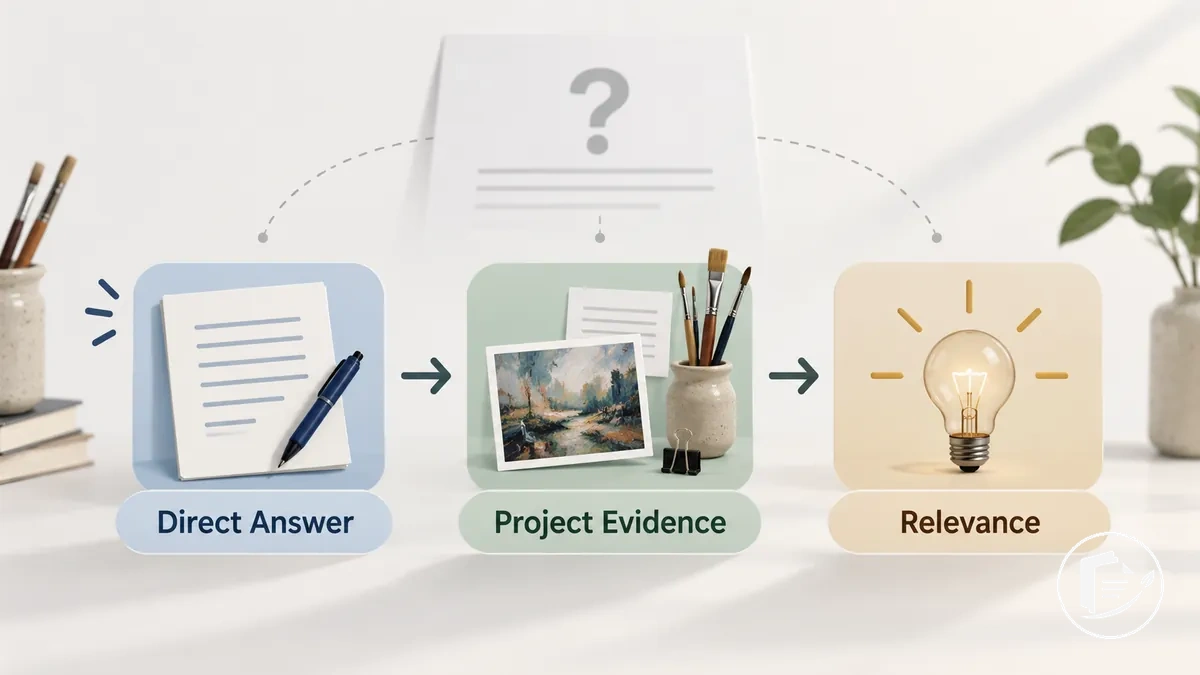
A grant application response structure is a reusable way to turn an interpreted prompt into a coherent answer through three stages: give a direct answer, support it with relevant project detail or evidence, and make its relevance to the prompt explicit.
The sequence organizes the minimum logic of an individual response without assuming the same structure overrides every grant's instructions.
The response structure can adapt to short answers, longer narrative responses, and prompts that call for different kinds or amounts of evidence, so the grant's stated instructions remain controlling.
It governs an individual answer rather than the broader art grant proposal method.
Follow the three stages in order, keeping each later stage consistent with the direct answer established at the start.
- State the direct answer. Answer the prompt's central requirement so the response establishes its main point immediately.
- Support it with project detail or evidence. Add specific information that gives the direct answer concrete support and appropriate specificity.
- Connect the support to the prompt. Explain the relevance or implication of the supporting detail so its connection to the question requirement is clear.
Lead With the Direct Answer
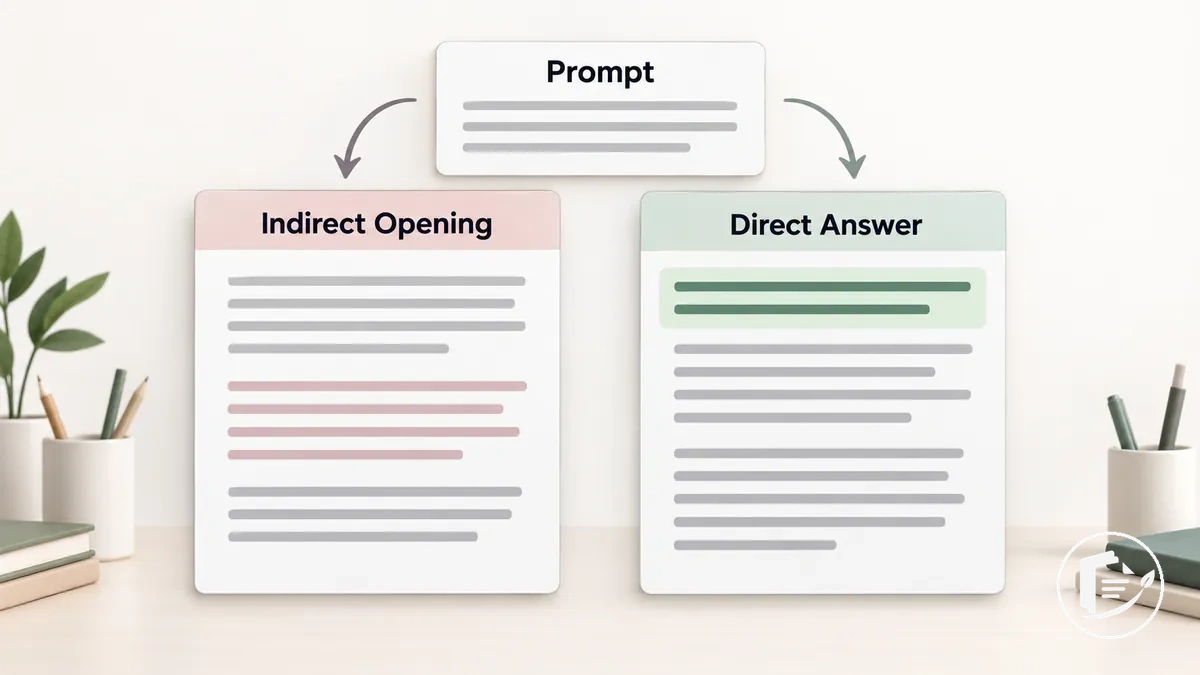
The first sentence should give the direct answer the prompt requests when the question permits one, naming the relevant project, goal, need, audience, activity, or result.
This opening states the requested point before background or explanation.
If a qualification materially changes the answer, include it in that first sentence rather than making an overbroad claim.
Background can follow when it clarifies the direct answer, while a multi-part or conditional prompt may need a compact qualifier before further explanation.
The image compares an indirect opening with a direct opening and highlights the sentence that actually answers the prompt.
Keep the direct answer as the base for the supporting project detail that follows.
Support the Answer With Specific Project Details
Relevant project details make an answer concrete by supplying specific information that supports what the response says about the project.
A useful project detail identifies an actual activity, participants or audience, location, timing, scale, or intended result when that information helps answer the prompt.
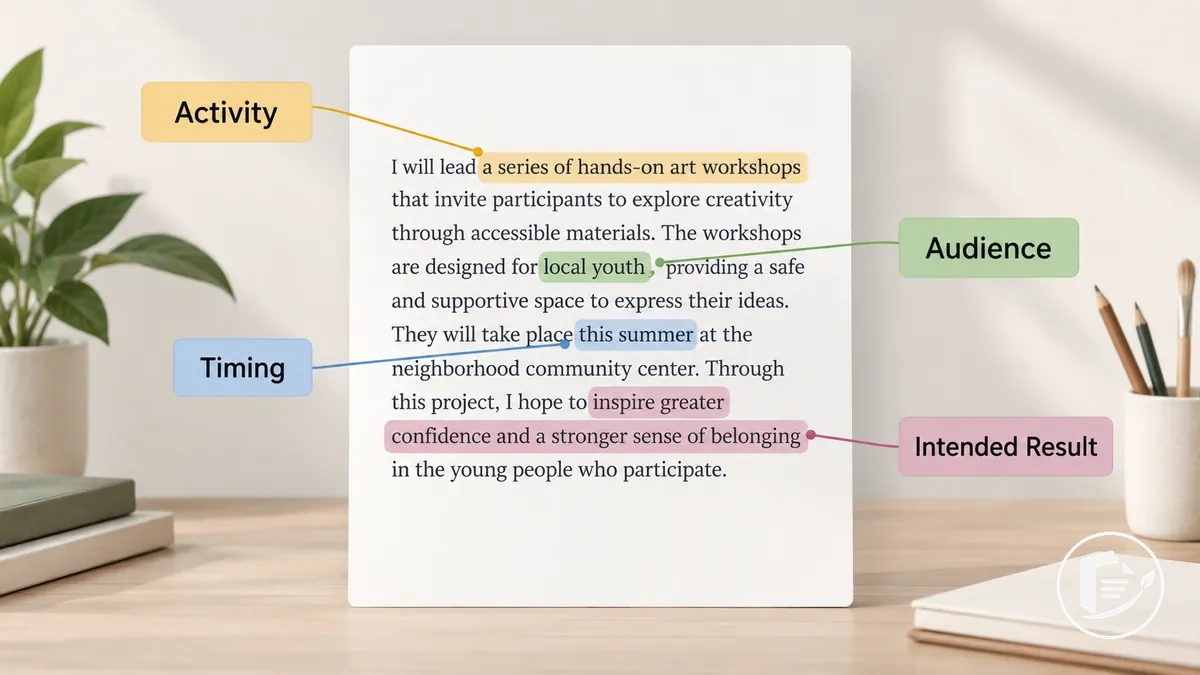
Each detail functions as evidence only when it adds relevant specificity to the current answer.
An activity can specify what will happen, participants or audience can identify who is involved, location and timing can clarify the project context, and scale or intended result can define the scope or expected result when the prompt calls for that information.
Keep the project details that strengthen the answer, and leave out specific but unnecessary background.
Connect the Supporting Details Back to the Question
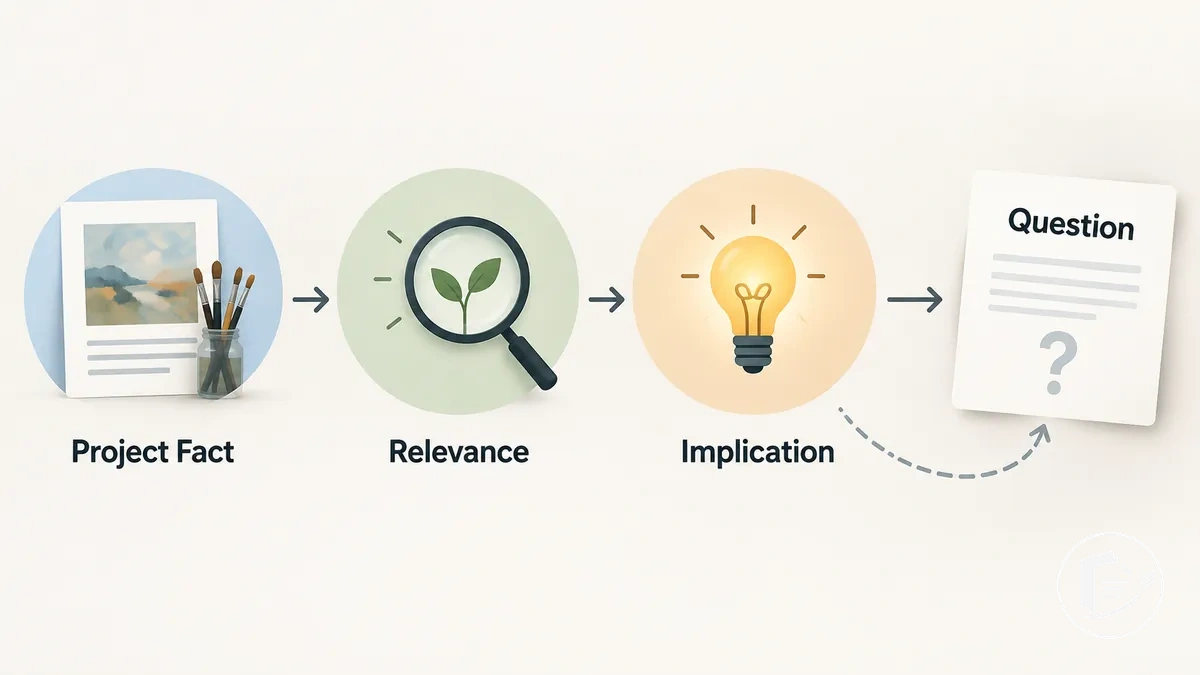
A supporting detail is useful only when its relevance to the question is explicit and tied to the attribute the prompt asks about.
The project fact then functions as evidence for that specific response requirement rather than as disconnected background.
For example, if a question asks how an illustrative project will reach its intended audience, free community workshops are the project fact; their relevance is that the activity gives the audience a defined way to participate; the implication is that the response identifies a concrete audience-access method.
The implication should match the attribute the prompt asks reviewers to assess, while the broader context can help applicants understand what reviewers assess under the relevant grant criteria.
The image maps one supporting fact through its relevance to the implication it establishes for the question.
Answer Project Purpose, Goals, and Impact Questions
Project purpose, project goals, and project impact are related but distinct question types because each asks for a different part of the project's meaning.
Purpose explains the project's significance, goals state its intended achievement, and impact describes the expected effect or expected outcomes for an audience, community, artistic practice, field, or other relevant context.
- Purpose: Explain why the project matters by identifying the need, significance, or reason for undertaking it.
- Goals: State what the project intends to achieve, keeping the intended achievement distinct from the activity used to pursue it.
- Impact: Describe the effect or expected outcomes the project is intended to have in the context named by the question.
Funders may phrase these questions differently or may not use the labels purpose, goals, and impact at all, so classify the question by the meaning it requests rather than by a particular term.
For one illustrative artist project, a purpose answer could explain why access to a particular artistic experience matters, a goals answer could state what the project intends to achieve, and an impact answer could describe the expected effect on the relevant audience or context.
The following subsections develop each response type in more detail.
Explain Why the Project Matters
Explain the project's significance by connecting it to a relevant need, opportunity, context, or intended benefit rather than simply asserting that the project is important.
- Ground the significance.Connect the project to a relevant audience, participants, artistic context, need, opportunity, timing, or intended benefit rather than relying on personal importance alone.
- Explain the connection.Show how the project responds to that context so the reason for undertaking it is explicit and grant-relevant.
- Keep the claim proportionate.Frame intended benefits in line with the project’s scale and supportable evidence, using conditional language when benefits depend on future participation, delivery, timing, or other conditions.
This connection establishes why the project has grant-relevant significance without claiming broader effects or outcomes that the application cannot support.
State Project Goals Clearly
A project goal should state the intended achievement, not simply name the activity used to pursue it.
Activity is not the goal
Activity
States what the project will do: for example, “run a series of workshops”.
Goal
States the intended achievement: for example, “increase opportunities for the intended audience to participate in the project”.
Add audience, scope, or timeframe only when it helps answer the prompt or makes the intended result clearer.
Keep the project goal focused on the intended state the planned activities are meant to support, without forcing artificial measurability onto a legitimately qualitative outcome.
Describe Project Impact and Expected Outcomes
Describe expected project impact by identifying who or what may change and the nature of the expected change.
Keep the impact chain precise
Output
An immediate project result, such as delivering a planned workshop.
Expected outcome
A change that may follow for the audience or another affected entity, such as participants gaining an opportunity to engage with the artistic activity.
Supporting observation
Documented participation or participant feedback can support the connection between the activity and the expected effect when appropriate to the claim.
Claim boundary
Describe the effect the project could contribute to; do not present broader future change as guaranteed when the proposed activity cannot support that certainty.
Write Concise Answers Within Word or Character Limits
Treat an explicit word limit or character limit as a response constraint and keep the answer within the stated maximum unless the funder states otherwise.
Aim for completeness and relevance within that constraint rather than filling every available word or character; the must-keep content is the direct answer and essential information, while setup or repetition that adds little meaning can be cut.
A word limit constrains the number of words, while a character limit constrains characters according to the counting rule used by the application system.
If the application system states how it calculates the count, follow that rule rather than assuming every platform counts text in the same way.
Use the four-step compression process to make the response concise while preserving its core meaning, then verify both completeness and the final count.
- Identify required content. Preserve the direct answer and essential information needed to satisfy the prompt so the response keeps its core meaning.
- Remove low-value setup. Cut introductory or background wording that does not materially improve the answer's relevance to the question.
- Tighten wording and duplication. Shorten phrases and remove repeated meaning while retaining necessary project-specific evidence and context.
- Verify the count and completeness. Check the final count against the stated word limit or character limit and confirm that the shortened answer still contains the required information and intended meaning.
Prioritize Essential Information Before Cutting Words
Protect the essential information in a grant answer before editing it for length: preserve the direct answer and the support required by the prompt before optional background.
Project detail or evidence that makes the answer specific should remain when it is necessary to support the response, while optional detail should be considered only after the required content is protected.
Rank each information item by how directly it contributes to the prompt: essential information satisfies the question, useful information adds relevant context, and expendable information can be removed without weakening the core response.
For example, preserve a project detail that provides necessary evidence and the implication that explains its relevance, while secondary examples or background may be removed first when they are not required to answer the question.
- Preserve the direct answer. Protect the statement that directly satisfies the prompt so compression does not remove the response's core meaning.
- Preserve necessary evidence and implication. Keep the project detail or evidence needed to support the direct answer and the implication that connects that support to the prompt.
- Remove optional material first. Cut background, optional detail, or secondary examples before required content when those elements add less response value under the tighter limit, then verify that the direct answer and necessary evidence still remain.
Remove Repetition Without Removing Specificity
Remove repetition and low-information wording before cutting concrete project detail from a grant answer.
Preserve the specific actor, action, context, and intended result because these elements carry the meaning that distinguishes the response.
Start by removing repeated setup and a duplicated claim, then tighten unnecessary phrasing and any qualifier that is not needed for accuracy.
Context can be shortened when it repeats information already established, but retain project detail that preserves specificity.
After editing, check that the concise version still carries the same specific meaning through its actor, action, context, and intended result.
Keep Answers Consistent Across the Grant Application
Keep recurring project facts consistent across separate application answers so each response describes the same underlying project.
The wording and level of detail can change with the prompt, but a shared fact should not change simply because it appears in a different answer.
Check recurring attributes such as the project goal, audience, activity, timing, scale, and expected outcome for alignment across responses.
Different questions may require one attribute to receive more detail or a different emphasis.
That framing can vary without creating a contradiction when the underlying project fact remains the same.
- Goal: Keep the intended achievement consistent even when one answer explains its significance and another focuses on delivery.
- Audience: Use the same audience when the answers refer to the same participant or beneficiary group, unless the prompt legitimately addresses a different group.
- Activity: Keep the proposed activity aligned across application answers while adjusting the amount of detail to the question.
- Timing: Preserve the same project timing when it represents a settled project fact; incompatible dates create a factual contradiction.
- Scale: Keep stated project scope consistent when the same aspect of the project is being described.
- Expected outcome: Maintain the same intended result while allowing its framing to reflect the specific question.
Legitimate reframing changes emphasis or detail without changing the underlying fact, while a contradiction gives incompatible versions of that fact; for example, describing the same project as serving emerging artists in one answer and school students in another would conflict unless both groups genuinely have distinct roles in the project.
After checking that recurring facts align across the application answers, review answers before submission as part of the broader pre-submission review.
Correct Common Problems in Grant Application Answers
Weak grant application answers often fail in two ways: they miss part of the prompt or make claims without enough project-specific support.
These mistakes can reduce clarity and make it harder for reviewers to identify the information the response is meant to provide.
The two problem classes require different corrections.
A missing requirement is corrected by addressing the unanswered part of the prompt, while a generic claim is corrected by adding relevant project detail or evidence that makes the statement specific.
The child sections provide the concrete examples for recognizing and correcting each mistake.
- Does not fully answer the question: The answer misses a required element of the prompt, which weakens responsiveness and leaves part of the requested information unstated.
- Makes claims without enough project detail: The answer relies on a generic claim without sufficient evidence or specific project detail, which can obscure what the claim means in the context of the project.
Answers That Do Not Fully Address the Question
An answer can be relevant to the general topic yet remain incomplete when it misses a required part of the question.
The missing requirement is the specific prompt element that the response must add to become complete.
An answer may address only one clause of a multi-part prompt, provide background instead of the requested explanation, or discuss an adjacent issue without stating the requested conclusion.
These responses can remain on-topic while omitting information the question explicitly requests.
The correction is to identify the omitted requirement and add only the information needed to address it without introducing unrelated material.
Generic Claims Without Specific Project Detail
Replace a generic claim with relevant project detail that specifies what activity will happen, who the audience or participants are, and the place, timing, scale, or intended result when those attributes help answer the prompt.
Specificity comes from concrete project facts rather than stronger descriptive language.
Use only project information that is truthful, relevant, and established for the application rather than adding unsupported precision.
A place, timing, or scale should be included only when it materially clarifies the answer, while a prospective intended result should remain framed as an intention rather than a guaranteed outcome.
The specific version below replaces vague wording with concrete activity and audience details and connects the intended result more clearly to the question.