
How to Prepare a Letter of Support for an Artist Grant
A letter of support for an artist grant should identify a credible supporter, explain their relationship to the artist or project, state the specific endorsement or commitment they can substantiate, and show how that support helps the proposed project. Follow the funder’s current instructions first: they determine whether a letter is required, optional, restricted, or not accepted and may set submission or authentication requirements.

Artist grant support-letter blueprint
Use this sequence to turn third-party support into a clear, attributable document that matches the grant application.
-
Check the funder’s rulesConfirm whether the letter is required, optional, limited to certain circumstances, or not accepted, and note any submission conditions.
-
Choose a credible supporterPrefer relevant first-hand knowledge and a legitimate project relationship over prestige alone.
-
Identify the application preciselyUse the artist or applicant name, project title, and funding opportunity details that match the application.
-
State the support and its conditionDescribe the endorsement, access, collaboration, expertise, in-kind contribution, or other support the writer can substantiate, including whether it is confirmed or conditional.
-
Connect support to a project needExplain what the support enables or contributes, then close with attributable signatory details and any funder-required verification elements.
Decision rule: the strongest letter is project-specific, verifiable, internally consistent, and compliant with the applicable funder instructions.
Before drafting, align the supporter’s identity and first-hand relationship with the support they can truthfully state and the project need that support addresses. A support letter can document credible third-party backing, but it does not replace the artist’s eligibility or the quality of the proposal.
Table of Contents
What a Letter of Support Does in an Artist Grant Application
A letter of support provides attributable third-party support for claims made within an artist grant application.
It can substantiate an endorsement, commitment, collaboration, or relevant project support when the writer has credible knowledge of those claims.
Depending on the writer relationship and what the supporter can credibly attest, the letter may also support claims about project feasibility or community relevance.
The value comes from connecting identifiable external backing to the specific project rather than offering general approval.

The writer relationship establishes why the supporter has credible first-hand knowledge, while the endorsement or commitment identifies what that supporter can substantiate or contribute.
The relationship among the supporter, artist, project, and application provides the context needed to interpret that support.
Within the broader practice of grant writing for artists, the letter serves as supporting evidence rather than a substitute for the application’s own claims and requirements.
Generic praise states approval, while useful project-specific support identifies what the writer knows, endorses, or will contribute.
This distinction keeps the letter of support focused on verifiable third-party backing and its relevance to the artist grant application.
When an Artist Grant Requires a Letter of Support
Whether a letter of support is required depends on the specific funding program’s current application instructions.
Those instructions determine the letter-of-support requirement separately from any submission condition governing how an accepted supporting document must be provided.
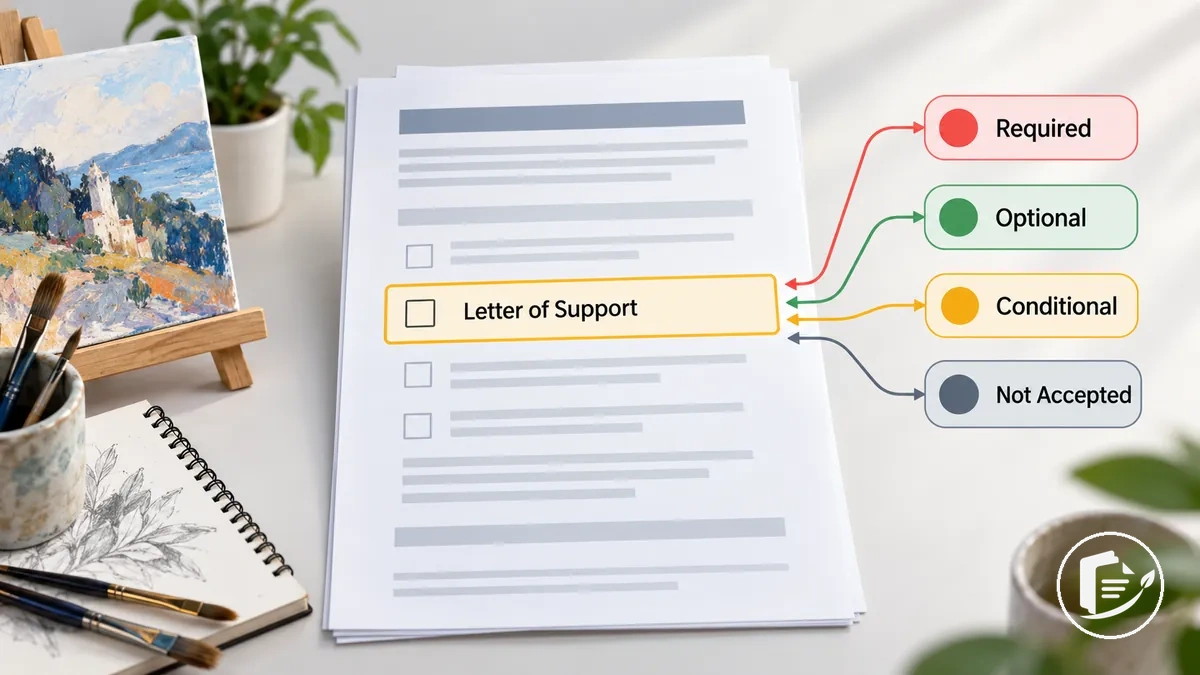
Requirement status → applicant action
- Required: If the funding program requires a letter of support, the applicant should include it and follow the stated submission conditions.
- Optional: If the application instructions permit an optional letter, the applicant may include one when it provides relevant support for the grant application, subject to the program rules.
- Limited or conditional: If the funding program permits a letter only in specified circumstances, the applicant should submit it only when those stated conditions apply.
- Not accepted: If the program does not accept a letter of support or other extra material of that kind, the applicant should not add one to the submission.
The document status comes from the funder guidance, while broader artist grant application requirements belong to the wider application context.
Requirement status determines whether the supporting document belongs in the grant application, while any stated submission condition determines how it must be provided.
If the current instructions do not specify the status clearly, the applicant should verify the program rules rather than infer them from another funding opportunity.
For example, an arts funding program might require project-specific support for a particular application, while another might permit an optional endorsement or decline extra supporting documents.
In each case, the applicable instructions determine whether the letter belongs in the grant application and what action the applicant should take.
Who Should Write the Letter of Support
An appropriate writer is usually a person or organisation with a relevant, credible, first-hand relationship to the artist or proposed project and a legitimate basis for stating the support offered.
The writer should be able to connect their role and first-hand knowledge to an endorsement or commitment they can substantiate.
Writer suitability therefore depends on relevance and evidentiary value rather than prestige alone.

Writer suitability criteria
- Relevant relationship: The writer should have a relationship to the artist or proposed project that makes their support relevant to the application.
- First-hand knowledge: The writer should know the artist's work, the proposed project, or the relevant project context directly enough to make credible statements about it.
- Legitimate role: The writer's role should provide a clear basis for the support being offered, such as involvement as a collaborator, venue or host, project partner, or community stakeholder when that relationship applies.
- Credibility: The writer should be able to speak from relevant knowledge or involvement rather than relying on seniority or institutional status as a substitute for project knowledge.
- Verifiable support: The writer should be able to verify the endorsement or commitment they state, including any involvement or contribution they genuinely intend to provide.
These criteria connect the writer's relationship and role to the credibility and usefulness of the support.
A collaborator may be appropriate when they have worked directly with the artist, while a venue representative, project partner, or community stakeholder may be appropriate when their role gives them relevant knowledge of the proposed project.
The applicable project context and funder instructions determine whether a particular relationship is suitable for the grant application.
For example, a directly involved project partner may provide more relevant evidence about a planned collaboration than an unrelated high-status person without first-hand knowledge of the work.
The selection logic is the writer's relevant relationship, credible knowledge, and ability to substantiate the support offered.
What an Artist Grant Letter of Support Should Include
An artist grant letter of support should identify the writer and their relationship to the artist, identify the proposed project and relevant funding opportunity, state the endorsement or commitment clearly, and connect that support to the project.
It should also make authorship attributable through the writer identity and, where required by the funder instructions, appropriate contact details or other verification information.
Together, these components establish who is providing the support, what is being supported, and why that support is relevant to the application.

Specificity helps each component perform a distinct function within the support letter: identity establishes authorship and context, the endorsement or commitment states the support being offered, and project relevance connects that support to the proposed work.
These elements should remain internally consistent so that the writer's stated relationship, knowledge, and support refer to the same artist and project rather than reading as generic boilerplate.
Signatures, contact details, letterhead, identifiers, or other verification elements should follow the applicable funder instructions rather than being treated as universal requirements.
Each component therefore contributes a distinct function to the completeness, clarity, and attributable authorship of the letter.
Establish the Writer’s Relationship to the Artist or Project
The writer should state their role or organisation and explain the relationship that connects them to the artist or project.
The relationship should make the writer’s first-hand knowledge and basis of knowledge clear rather than relying on title or affiliation alone.

The writer can identify the type of working relationship and, when useful, its relevant duration or depth to explain how they know the artist or project.
Credibility comes from the relationship’s relevance to what the writer can substantiate, not from duration alone; for example, describing direct collaboration on a specific arts project provides a clearer basis of knowledge than simply stating that the writer has known the artist for some time.
Identify the Artist, Project, and Funding Opportunity
The letter should identify the applicant or artist by the exact name used in the application and state the project title clearly.
The relevant funder, funding opportunity, grant program, round, or identifier should be reproduced exactly when that information is required by the applicable instructions or supplied for the application.
Names and identifiers should match the submitted application so the letter can be associated unambiguously with the correct artist and project.
If a program identifier or reference number has not been supplied or its required form is unclear, the writer should verify it rather than infer or invent a value.
Describe the Support or Commitment Being Offered
The letter should state the support or commitment being offered in concrete terms rather than relying on general enthusiasm.
The supporter should identify the actual endorsement, collaboration, access, expertise, in-kind contribution, or other project support they can substantiate, with enough scope to make the commitment clear.
Confirmed vs conditional support
Confirmed support
Use a definite statement when the supporter can substantiate an agreed commitment, such as hosting a project activity or contributing specific expertise.
Conditional support
State the condition when support depends on funding, scheduling, approval, availability, or another requirement; do not present a conditional commitment as guaranteed.
Key distinction: replace vague approval with a specific, verifiable commitment connected to the project, and state any condition that changes whether it will occur.
Connect the Support to the Proposed Project
The letter should connect the support or commitment to the specific project activity, project requirement, or constraint it addresses within the proposed project.
For example, confirmed access to a venue can enable the activity planned for that venue, while a relevant contribution of expertise can support the project activity that requires that expertise.
The practical effect should match the scope and condition of the contribution: support may improve the project's feasibility, provide necessary access, support delivery, or contribute to reach when the stated commitment actually addresses that project need.
If the contribution depends on funding, scheduling, availability, or another condition, its effect on the proposed project should be described conditionally rather than as an assured outcome.
Close with Clear Endorsement, Signature, and Contact Details
The closing should confirm the writer's endorsement and identify the signatory clearly enough for the letter's authorship to be attributable and, where required, available for verification.
The checklist separates core attribution details from signature, date, contact details, letterhead, or authentication requirements that may depend on the funder instructions.
Closing and attribution check
- Endorsement: Confirm the support being given without introducing new project claims.
- Signatory identity: Provide the signatory's name and relevant role or organisation so authorship is clear.
- Signature and date: Use the signature or approved authentication method and date required by the applicable funder instructions.
- Contact details: Provide the contact details required for attribution or verification rather than assuming a universal set of contact fields.
- Program-specific requirements: Verify whether the funder instructions require letterhead, a particular authentication method, or another closing format.
A handwritten signature, letterhead, particular date field, or specific contact detail should not be treated as universally required when the funder specifies another method or does not request it.
Before finalising the closing, verify the applicable funder instructions so the endorsement and signatory details meet the required authentication and submission conditions.
Length, Format, and Specificity of the Letter
If the funder instructions state a page or word limit for the letter of support, that limit controls the document length.
When no limit is specified, the letter should be concise enough to avoid repetition while still substantiating the writer's relationship to the project and the support being provided.
Concise does not mean omitting relevant evidence; it means keeping the detail needed to establish credible, project-specific support.
The four attributes below organise the conditions used to evaluate whether the letter is compliant, readable, and specific.
Four document-quality attributes
- Length
- Follow any stated page or word limit; without one, use only the length needed to substantiate the relevant relationship and support without unnecessary repetition.
- Format
- Match any submission format, file type, letterhead, or other document requirement specified in the funder instructions rather than assuming a universal format.
- Tone
- Use a clear, professional tone that communicates the support directly without exaggerated praise or unnecessary formality.
- Specificity
- Include project-specific detail that identifies what the writer knows or supports and how it relates to the proposed work, rather than relying on generic endorsement language.
Format, professional tone, and specificity remain distinct attributes: format concerns how the letter is presented, tone concerns how the support is expressed, and specificity concerns whether the statements provide concrete evidentiary value.
Requirements for file type, letterhead, signature, or other formatting elements apply when the funder instructions specify them; they should not be treated as universal rules.
The acceptable state is therefore a letter that matches the applicable submission requirements while communicating its support clearly and specifically.
For example, when two letters both comply with the same funder limits, a shorter letter containing concrete project-specific detail can communicate the relationship and support more clearly than a longer letter that repeats general praise.
Document length is different from writer lead time: the former concerns the length of the finished letter, while the latter concerns how much advance time the writer has to prepare it.
The appropriate length remains the length that complies with the funder instructions and provides sufficient specificity without unnecessary repetition.
Letter of Support vs Letter of Recommendation
A letter of support and a letter of recommendation can both provide third-party evidence in an artist grant application, but their common purposes and primary subjects differ.
A letter of support typically focuses on a project and communicates an endorsement, contribution, or commitment connected to that project, while a letter of recommendation commonly evaluates the artist or candidate through relevant qualifications, qualities, or professional assessment.
The useful comparison therefore considers purpose, primary subject, writer relationship, claims, and whether project-specific commitment forms part of the document.
These distinctions describe common functions rather than universal definitions because funder terminology can vary.
The comparison below separates the two document functions across the same dimensions so an applicant can identify what kind of evidence the funder is requesting.
Neither document type is inherently preferable; its grant use depends on the purpose specified in the application instructions.
| Dimension | Letter of Support | Letter of Recommendation |
|---|---|---|
| Primary purpose | Documents support, endorsement, or commitment relevant to the proposed project. | Provides a recommendation or professional assessment of the artist or candidate. |
| Primary subject | The project and the support connected to it. | The artist or candidate and the qualities, experience, or suitability being assessed. |
| Typical writer relationship | A writer relationship that gives the supporter relevant knowledge of, involvement in, or a role connected to the project. | A writer relationship that gives the recommender a credible basis for assessing the artist or candidate. |
| Type of claims | Claims about project-specific endorsement, support, involvement, access, contribution, or commitment that the writer can substantiate. | Claims assessing the artist's or candidate's relevant qualities, experience, work, or suitability that the writer can substantiate. |
| Project-specific commitment | May include a concrete commitment when that commitment is relevant to the requested project support. | Not necessarily part of the document's recommendation function unless the funder's definition or requested evidence includes it. |
| Grant-use implication | Used when the application seeks evidence of support or commitment connected to the project, subject to the funder's definition. | Used when the application seeks a recommendation or assessment of the artist or candidate, subject to the funder's definition. |
For example, a detailed professional recommendation about an artist's abilities does not by itself establish that a venue, collaborator, or other supporter has made a project-specific commitment when the application asks for that evidence.
Some programs may use support letter, recommendation letter, or reference letter differently, so the label alone should not determine the document's function.
The requested document type should be determined by the funder terminology, definitions, and instructions for the specific grant application.
Artist Grant Letter of Support Example
In this fictional example, Maya Chen is an artist seeking a funding opportunity for a community-based installation project called Shared Light, and Jordan Ellis is the program coordinator at the fictional Harbour Arts Collective, which has previously collaborated with Maya on public workshops.
The example shows how the supporter relationship, project identification, endorsement or commitment, project relevance, and contact details can work together in one coherent letter.
I am Jordan Ellis, Program Coordinator at Harbour Arts Collective, a fictional community arts organisation.
I have worked with artist Maya Chen through two community workshop projects and have direct knowledge of her collaborative practice and the way she develops participatory art with local groups.
I am writing in support of Maya's application for the fictional Horizon Community Arts Funding Opportunity for her proposed project, Shared Light.
Harbour Arts Collective endorses the project and, subject to the project proceeding as planned, intends to provide access to our workshop space for scheduled community-making sessions.
This commitment is relevant to the proposed project because the workshop space would give Maya an appropriate location for participants to develop the installation components before the final presentation.
Our involvement would therefore support the delivery of the community participation stage of the project, while the scope and timing of that access would remain subject to the agreed project schedule.
Based on my direct working relationship with Maya and my knowledge of the proposed activity, I support the development of Shared Light and the collaborative approach described for the project.
This endorsement reflects the specific involvement described above and should not be interpreted as a guarantee of funding or project outcomes.
Jordan Ellis, Program Coordinator, Harbour Arts Collective.
Contact details would be provided for verification as required by the applicable funder instructions.
The example demonstrates credibility by connecting the fictional supporter's direct relationship with the artist to a specific commitment and explaining its relevance to a defined project need.
Program-specific details such as signature method, letterhead, identifiers, or particular contact details should be adapted to the actual funder instructions rather than treated as fixed requirements.