An artist statement for a grant should explain what you make, how you make it, what ideas or concerns shape the work, and how those choices are visible in the submitted work. Follow the funder’s required length and format, then organise the statement from core practice → specific artistic choices and meaning → current direction when current development is relevant to the application; keep project logistics and promotional claims out unless they directly clarify the practice.
Grant artist statement blueprint
Use this as a drafting map, not a rigid template. The grant instructions govern the required length and format; the sequence below keeps the statement centred on the artistic practice.
1
Establish the core practice
Name what you make, the main medium or form when useful, and the central concern or working focus.
2
Connect choices to meaning
Explain how materials, process, form, subject matter, or presentation choices operate in the work and what they help express.
3
Show the current direction
When relevant to the application, close with what is continuing, changing, or developing now without turning the statement into a future project plan.
Length rule
Use the funder’s explicit word, character, page, or format limit as the governing constraint.
Keep aligned
Match the statement to the submitted work, current medium or form, terminology, time frame, and artistic goals.
Keep out
Remove duplicated project schedules, outputs, funding-case language, unsupported self-praise, and background that does not clarify the practice.
Revision test
Each sentence should add a new, specific understanding of the practice, the work, or the relationship between them.
Shape the statement for the specific grant: follow the funder’s instructions, match the submitted work, and include only background that helps reviewers understand the artistic practice.
Table of Contents⌄
What an Artist Statement Needs to Do in a Grant Application
The artist statement helps reviewers understand the artistic practice and interpret the submitted work.
Its grant-specific purpose is to explain the artistic concerns that shape the work, the working methods used to develop it, and the relevant trajectory of the practice.
Culture Works describes the artist statement as an opportunity to give panellists more detail about an artist's vision and artistic trajectory while elaborating on the artistic documentation submitted with the application.
A useful artist statement connects artistic concerns and working methods to features reviewers can encounter in the submitted work.
It should clarify how ideas appear through relevant choices such as medium, subject matter, materials, or process, rather than leaving the description of the artistic practice detached from the work samples.
The artist statement should also maintain consistency with the wider grant application: its description of the practice and work should align with the submitted materials without merely repeating information already covered by other application fields.
Within the broader process of grant writing for artists, the statement has a focused role: give reviewers relevant context for understanding the artistic practice and submitted work.
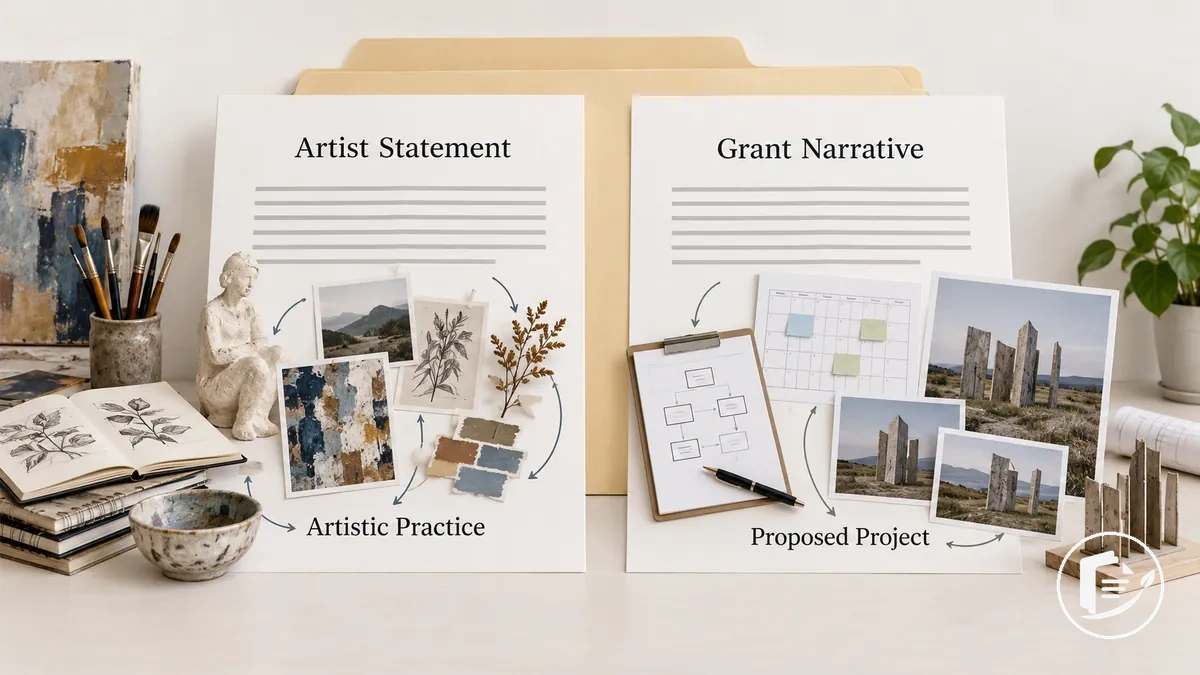
Artist Statement vs Grant Narrative
An artist statement and a grant narrative serve different functions within the same grant application.
The artist statement centres the artistic practice—its ideas, methods, and current direction—while the grant narrative generally centres the specific project, need, plan, activities, or case being proposed.
Keeping those subjects distinct helps each document contribute different evidence rather than duplicate the same information.
Funders may label or divide these fields differently, so the application instructions determine the exact boundary between them; within broader art grant proposal writing, the distinction is most useful when purpose, subject focus, time horizon, evidence, and duplication risk are compared on the same basis.
For example, a painter's artist statement might explain how layered translucent paint relates to an ongoing exploration of memory, while the grant narrative might explain how a proposed project will use that established approach to produce a new body of work.
The comparison below keeps those functions separate without treating either document type as universally defined.
Criterion
Artist statement
Grant narrative
Purpose
Explains the artistic practice and the thinking behind the work.
Explains the proposed project or case and what the applicant plans to do.
Subject focus
Artistic practice, ideas, methods, and current direction.
Project, need, plan, activities, and relevant rationale.
Time horizon
The practice and its relevant development or current direction.
The specific project period or proposed activity described in the application.
Evidence
Details of the work, methods, ideas, and practice that help interpret submitted work.
Project-specific details that support the proposed plan or case.
Duplication risk
Repeating project details that belong in the project-focused response.
Repeating the full description of the artistic practice instead of explaining the project.
Decide What to Include About Your Artistic Practice
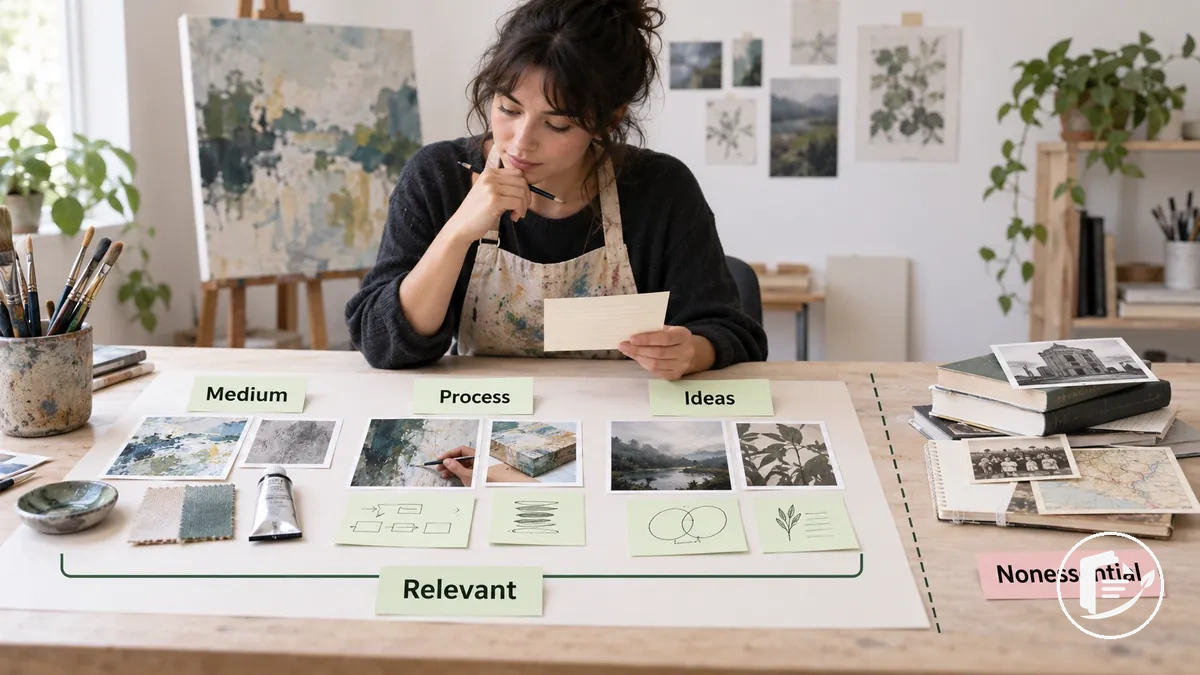
Include a detail when it helps a grant reader understand your artistic practice or interpret the submitted work.
Before drafting, filter possible material by relevance: what you make, the medium or methods involved, the process behind the work, the ideas or concerns shaping it, and the current direction of the practice can earn space when they clarify the work.
The grant’s requested materials and reader context can change which parts of the practice need the most explanation, so the application instructions take precedence over general writing conventions.
The Creative Independent similarly frames an artist statement around what an artist makes and why, while distinguishing it from a career-accomplishment list or an account of everything the artist has made.
Test each candidate detail by asking what attribute of the artistic practice it reveals, whether there is evidence of it in the current work, and what understanding it gives the grant reader.
A detail about medium should clarify something about the work rather than merely name a material; a detail about process or ideas should explain a choice, relationship, or concern that the submitted work can support.
Career history, personal background, theory, or project detail is relevant only when it materially helps explain the practice or the submitted work.
Practice relevance: Does the detail explain what you make or a meaningful feature of your artistic practice?
Method relevance: Does the medium, material, or process reveal how the work is developed or why a particular artistic choice matters?
Idea relevance: Does the detail clarify an idea, question, or concern that shapes the current work?
Support in the work: Can the submitted work give the grant reader evidence for the detail rather than leaving it as an unsupported description?
Contextual value: If the detail concerns career history, personal background, theory, or other context, does it improve understanding of the practice rather than function as decorative information?
For example, identifying a recurring material and explaining how its use relates to an idea visible in the current work is more practice-relevant than adding an unrelated career detail simply because it sounds notable.
Keep a candidate detail when it reveals something useful about the artistic practice or submitted work; otherwise, it does not need space in the statement.
Identify What You Make and How You Work
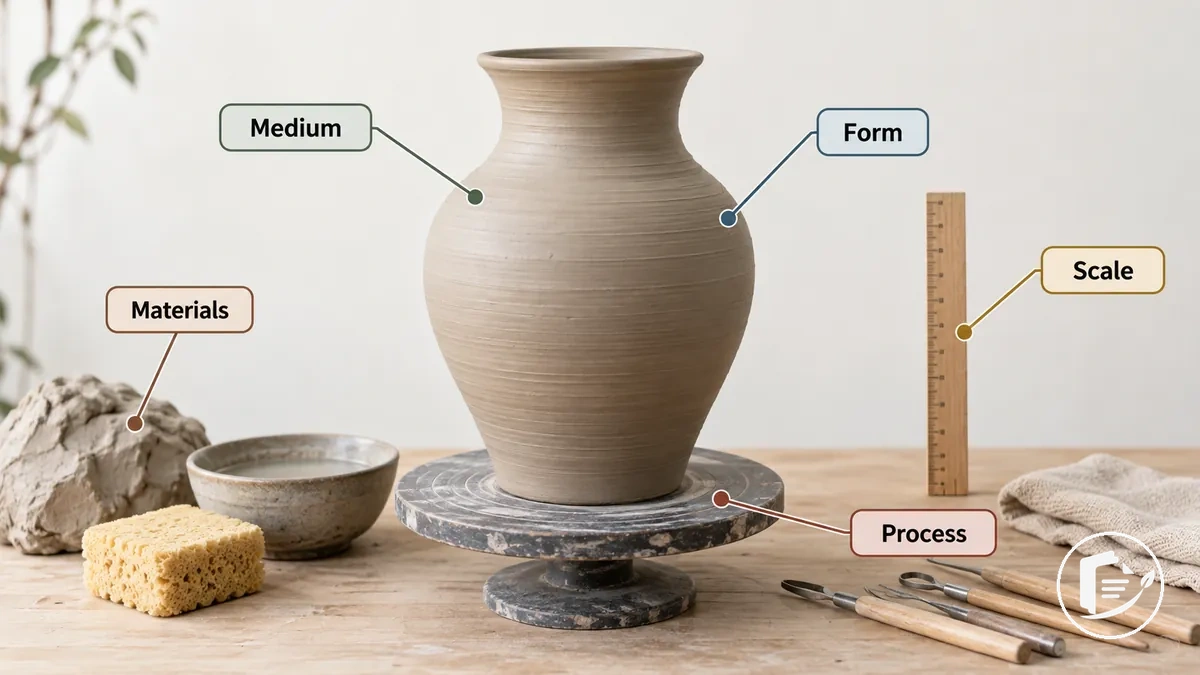
The concrete components of an artistic practice describe what the artist makes and how the work is produced.
These components can include medium, form, materials, techniques, process, scale, and recurring working methods, with emphasis on the elements that are relevant to the work.
Naming the component is only the starting point; describing its function makes the practice more specific and understandable.
Medium and form: Identify what kind of work you make and the form it takes, giving the reader a concrete basis for understanding the practice.
Materials: Name materials when they are characteristic of the work or help clarify how it is constructed, assembled, or presented.
Techniques: Describe techniques that show what you do with the medium or materials rather than using technical terminology without explaining its relevance.
Process: Explain the recurring actions or stages involved in producing the work when that process is a meaningful part of how the practice operates.
Scale and working methods: Include scale or recurring working methods when they help clarify how the work is made, experienced, or organised.
Specificity comes from connecting each component to its function in the work rather than creating an exhaustive materials list.
For example, instead of using “painting” as a bare medium label, an artist could describe making layered paintings with translucent applications of paint, identifying both the medium and how it functions within the work.
Identify the Ideas, Motivations, and Context Behind the Work
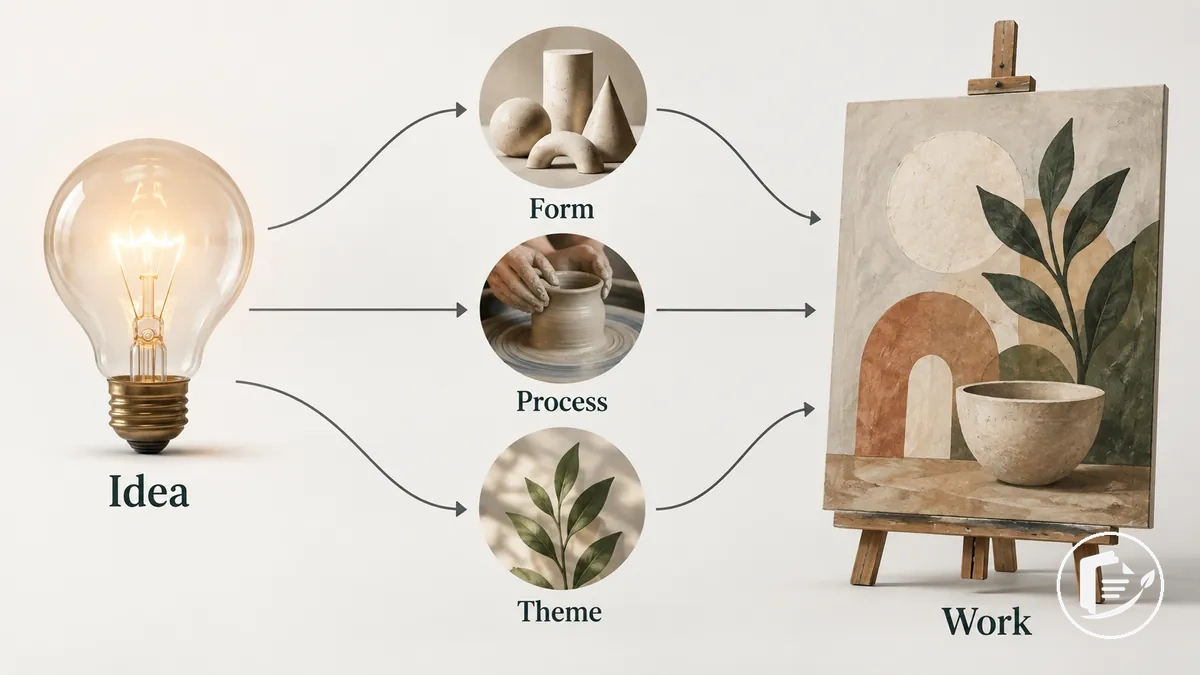
Ideas, motivations, questions, experiences, and context belong in an artist statement when they help explain how an artistic practice takes its particular form.
A relevant influence should connect to something observable in the work, such as an artistic choice, recurring theme, or aspect of the process, rather than remain as detached background information.
Personal, social, historical, or conceptual context therefore needs only the space that its connection to the work can support.
The connection should make clear how an influence informs or is reflected in the practice without claiming that it automatically causes a particular meaning or audience response.
For example, an artist concerned with repetition might explain that this concern is expressed through recurring forms or repeated actions in the process; those observable artistic choices provide evidence for why the idea is relevant to describing the work.
Context that cannot be connected to a theme, process, form, or other observable feature of the artistic practice functions as background rather than an explanation of the work.
Write the Artist Statement in a Clear Sequence
A clear artist statement usually progresses from the core practice to specific artistic choices and meaning, then to the current direction of the work.
This sequence gives each stage a distinct purpose: establish the practice, develop it with relevant evidence, and show how the work is developing now.
The exact progression can be adapted when the grant prompt or the nature of the artistic practice requires a different emphasis.
Adapt the sequence to the grant prompt rather than treating it as a fixed sentence pattern.
Use the three stages to organise the statement so that each one contributes new information before moving to the next.
Begin with the core practice: Establish what the artistic practice is and its central focus so the reader has a clear subject for the statement. Quick check: Does this stage establish the practice without using details that belong in the next stage?
Develop specific artistic choices and meaning: Connect relevant artistic choices to evidence in the work and explain what those choices reveal about the practice or its meaning. Quick check: Does this stage add specific evidence or explanation instead of restating the opening?
Close with the current direction: Explain how the practice or work is developing now when that direction is relevant to the application. Quick check: Does this stage add a current point of development rather than repeat or summarise earlier information?
Verify the finished sequence by checking that each stage adds new information before the statement moves on.
Open With the Core of Your Artistic Practice
The opening sentence should identify the artistic practice directly and establish the central concern or working focus that gives the work coherence.
Include the main medium or form when it helps a reviewer understand what the artist makes, then connect that concrete description to the focus of the practice.
Keep the artistic practice as the subject and use direct language so the opening provides specificity without a biographical preamble or unsupported claims about the work.
Opening sentence: vague vs specific
Vague
“My work explores important ideas through art.”
Specific
“My painting practice uses layered figurative forms to explore how personal memory changes over time.”
Why it works: the specific version identifies the artistic practice, medium, form, and central concern immediately, giving the reader a clear subject for what follows.
Develop the Statement With Specific Artistic Choices and Meaning
Develop the middle of the statement by connecting each concrete artistic choice to the idea, question, or function it expresses within the practice.
A medium, material, process, form, subject matter, or presentation choice should do more than identify what appears in the work; explain how its specific use contributes to meaning.
Keep the artistic choice close to the evidence that supports the interpretation so the reader can understand how the practice works rather than only what it is about.
Choice → observable effect → meaning
Artistic choice
Repeat the same form through a layered process.
→
Observable effect
The image is retained, altered, and partly obscured as layers accumulate.
→
Meaning in the practice
The repeated and layered form supports the practice’s concern with how memory changes over time.
Verify each interpretive claim by checking that the stated meaning can be connected to observable evidence in the work, whether that evidence comes from the medium, material, process, form, subject matter, or presentation.
Close With the Current Direction of Your Practice
Close the statement by describing the current direction of the artistic practice in present-tense terms, focusing on what is continuing or changing in the work now.
Connect evolving methods or ongoing questions to an observable development in the practice, such as extending an established process, testing a different form, or deepening an existing concern.
The current direction should show how the work is developing without predicting future success or turning the closing into a project plan.
Set the Right Length, Format, and Level of Detail
Grant instructions govern the artist statement's length and format, while the level of detail should be sufficient to explain the practice without reducing clarity or relevance.
Follow any stated word limit, character limit, page limit, or format requirement in the application rather than applying one universal standard.
Where the instructions leave room for editorial judgment, prioritise information that helps the reader understand the practice and work.
Length, format, and level of detail work as related constraints: externally imposed limits determine the available space and presentation, while editorial choices determine how that space is used.
Apply each criterion according to its governing condition and its implication for drafting or editing.
Length: When the grant instructions specify a word limit, character limit, or page limit, treat that limit as the governing constraint and compress or expand the statement within the permitted space without changing the core meaning of the practice.
Format: When the application requires a particular format, structure the artist statement to meet that requirement and edit its presentation accordingly rather than imposing a preferred format of your own.
Level of detail: Within the available length and format, include enough relevant detail to explain the practice and work clearly; remove detail that consumes limited space without improving clarity or understanding.
A tight limit requires greater compression of the same core practice, while a more generous limit allows relevant ideas, methods, or context to be developed further.
The appropriate level of detail therefore adapts to the application's constraints rather than to a fixed length for every artist statement.
Match the Length to the Grant Instructions
Follow the grant's stated word limit, character limit, or page limit before applying generic artist-statement conventions.
The grant instructions define the relevant length condition for that application, so the statement should be edited to fit the space the funder provides.
When space is restricted, compression should preserve the core practice, specific choices, and essential context before secondary explanation.
Hard limit: When the grant instructions set an explicit maximum, the limit requires the statement to fit within that stated boundary, so prioritise the information needed to understand the practice and compress supporting detail.
Suggested limit: When the instructions provide a suggested limit rather than a fixed maximum, use it as guidance for the expected scope while adjusting the level of explanation when relevant information warrants it.
Open-ended instruction: When no word limit, character limit, or page limit is stated, the instruction leaves statement length open to editorial judgment, so include enough evidence and nuance to explain the practice without adding repetition.
The amount of compression therefore changes with the limit condition: tighter space reduces supporting detail, while more available space allows relevant evidence and nuance to be developed.
For example, when shortening a longer statement, preserve the description of the core practice, the specific choices that explain how the work operates, and the essential context needed to interpret those choices before removing secondary background or repeated explanation.
This keeps the statement's meaning intact while adapting its length to the application.
Match the Statement to the Work Samples and the Rest of the Application
The artist statement should align with the work samples and application responses without duplicating them.
New York Foundation for the Arts advises applicants to edit an artist statement so it matches the work samples submitted with a specific application.
Its description of the artistic practice should match the concerns, media, and current direction demonstrated by the submitted work, while factual claims and terminology should remain consistent across the application.
Consistency means aligned facts and framing, not identical wording.
Verify the statement against the submitted materials by checking the same practice attributes across each source.
Where a time frame, medium, or artistic goal legitimately differs, make that distinction clear enough that the difference does not appear to be an unexplained mismatch.
Practice description: Check that the artistic practice described in the statement corresponds to the practice represented by the submitted work rather than an outdated or broader version of it.
Terminology: Verify that important terms for media, methods, themes, and bodies of work are used consistently with the application responses.
Time frame: Check that references to current, past, or developing work match the relevant time frame shown or described elsewhere in the application.
Artistic goals: Confirm that the artistic goals stated here align with related claims in other application answers without repeating those answers.
Work-sample support: Verify that the work samples provide observable support for the statement's description of the practice, concerns, media, and current direction.
For example, if an older statement describes sculpture as the main practice but the submitted work samples and current application focus on an established shift to installation, revise the statement to describe that current practice and explain only the relevant continuity with the earlier work.
The goal is alignment across the materials, not duplication.
Artist Statement Example: How the Parts Work Together
This model artist statement uses a fictional painting practice to show how artistic practice, medium, process, ideas, artistic choices, and current direction can work together with specificity and coherence.
Notice how each sentence adds a different function rather than repeating the same description of the work.
Model statement, sentence by sentence
1. Core practice + medium
My artistic practice uses layered figurative painting to examine how personal memory shifts over time.
Establishes the practice, medium, and central concern.
2. Process + artistic choices
I work with translucent paint, repeated forms, and partially obscured imagery so that the process of building and revising each surface reflects the instability of remembered experience.
Shows how specific materials and process operate within the work.
3. Choices + meaning
These artistic choices connect the physical construction of the work to ideas about what is retained, altered, or lost through recollection.
Connects observable choices to the ideas they support rather than relying on abstract claims.
4. Current direction
My current direction extends this process by introducing fragmented architectural forms and testing how remembered places can be reconstructed through overlapping images.
Shows how an established method is developing now.
The wording, medium, voice, and emphasis can change for another artist or grant; the transferable principle is that each sentence performs a distinct function while remaining coherent with the same practice.
Correct Common Artist Statement Mistakes Before Submission
Revise artist statement mistakes that reduce clarity, specificity, relevance, or consistency before submission.
The most useful corrections target wording or content that obscures the artistic practice, duplicates other application material, or conflicts with the submitted work.
A relevant mistake is therefore one that can be identified in the statement and corrected without broadening the revision into general grant-writing advice.
For each mistake, identify its consequence, look for an observable recognition cue, and apply a specific correction.
This approach turns vague editing advice into a practical diagnostic check.
Vague claims: They weaken specificity by leaving the artistic idea or choice undefined. Recognition cue: A sentence uses broad terms such as “important themes” or “unique work” without identifying the theme, choice, or evidence. Correction: Replace the vague claim with the specific idea, medium, process, or artistic choice it is meant to describe.
Unexplained jargon: Jargon can obscure meaning when a specialised term is necessary to the practice but its function is not clear from context. Recognition cue: A reader would need outside knowledge to understand what the term means for the work. Correction: Use plainer terminology where possible or briefly explain the term through its role in the artistic practice.
Unsupported self-praise: Evaluative claims about quality or originality do not explain how the work operates. Recognition cue: The statement describes the work as exceptional, innovative, or powerful without connecting the claim to an observable artistic choice. Correction: Replace self-praise with concrete information about the work, process, ideas, or choices.
Repetition: Repeating project descriptions, biography details, or other application responses uses space without adding statement-specific understanding. Recognition cue: A passage substantially restates information already explained elsewhere in the application. Correction: Keep only the information needed to explain the artistic practice and its relationship to the submitted work.
Mismatch: A statement that describes a different medium, concern, or current direction from the submitted work can make the application less consistent. Recognition cue: The statement appears outdated or broader than the work samples it accompanies. Correction: Revise the description to align with the current submitted work while retaining earlier context only when it helps explain the present practice.
Unnecessary background: Background detail weakens relevance when it does not clarify the artistic practice or submitted work. Recognition cue: Removing the detail would not change the reader's understanding of what the artist makes, how the work is developed, or what concerns shape it. Correction: Remove or compress the background and use the space for practice-specific information.
A concise correction can change both meaning and readability: instead of “My innovative work explores important social themes,” write something specific such as “My photographic practice documents changes in shared public spaces through repeated images made at the same locations.” This replaces vague claims and unsupported self-praise with observable information about medium, process, and subject.
Practical revision should make each sentence contribute clearer evidence about the artistic practice rather than merely make the language sound more impressive.
Replace Vague Claims and Art Jargon With Specific Language
Replace vague claims with specific language that names the material, method, visual decision, subject, or process actually being described.
Art jargon can also obscure meaning when a specialist term appears without enough context to show its function in the artistic practice.
When a technical term is genuinely relevant, define or contextualise it rather than removing it automatically.
Three specificity upgrades
Vague: “My work explores transformation through experimental materials.”
Specific: “I cut, layer, and reassemble discarded paper so that earlier printed surfaces remain partly visible beneath new forms.”
Adds the material, method, and visual decision that were missing.
Vague: “My process investigates liminality.”
Specific: “I use photographs of transitional spaces such as corridors and thresholds to examine places experienced between arrival and departure.”
Gives the specialist idea context by naming the subject and its relationship to the work.
Vague: “My paintings communicate tension through abstraction.”
Specific: “I place tightly repeated geometric forms beside irregular painted marks, using the contrast between controlled and disrupted shapes to develop visual tension.”
Specifies the visual decision and explains its function instead of leaving the claimed effect unsupported.
Avoid Repeating the Project Description or Grant Narrative
Keep the artist statement focused on information that explains the artistic practice rather than material that merely duplicates the project description or grant narrative.
Use a simple revision test: ask whether each sentence adds understanding of the practice or current work, or only restates what the applicant plans to do.
Some project context can remain when it directly clarifies the artistic practice or submitted work, so the boundary should be based on function rather than absolute separation.
Look for repetition of project activities, schedule, outputs, or funding case language that already belongs to a project-focused application field, then trim or relocate details that do not add practice information.
Project detail vs practice-relevant context
Mostly project logistics
“The project will run for six months and produce twelve works for an exhibition.”
Practice-relevant context
“The proposed body of work extends my current practice of constructing layered images from archival photographs.”
The first version mainly restates schedule and outputs; the revision explains how the proposed work relates to the existing practice.
Preserve consistency across application fields, but place each detail where it creates the greatest information gain rather than repeating the same content.