
Artist Grant Application Examples: What Strong Proposals Show
Strong artist grant application examples are most useful as models of relationships, not wording: a clear project purpose should connect to activities and outcomes, important claims should connect to relevant evidence, and the project plan should agree with the budget and artist context. Adapt those relationships to the current grant’s prompt, criteria, and your own verified project facts; a successful example shows what worked in one funding context, not a guaranteed formula for funding.

How to read a strong grant example
Trace the relationships the example makes explicit. The aim is to see how a reviewer can move from the grant requirement to the project logic without having to supply missing connections.
- Prompt & criteriaIdentify what the response must answer and which assessment criteria control the context.
- Project claimFind the purpose, scope, activities, audience or participants, and intended outcomes the applicant actually proposes.
- Evidence & deliveryTrace the work samples, experience, project details, timing, resources, and other evidence that support material claims and feasibility.
- Cross-section consistencyCheck that the narrative, artist context, activities, outcomes, and budget describe the same project without unexplained contradictions.
Transfer the logic, not the wording. Rebuild each relationship with your own facts and recheck it against the current grant; funding outcomes remain specific to the opportunity and competition.
Reviewer expectations can therefore differ between opportunities, so a proposal example should be interpreted against the criteria and context that applied to that application.
The transferable lesson is the relationship among the parts of the grant proposal: specific project information supports the rationale, evidence supports important claims, and consistent details help a reviewer assess the application as a whole.
Studying that structure is more useful than copying context-specific wording because clarity, specificity, coherence, and consistency are observable qualities of a strong proposal, while the funding outcome remains context-dependent.
Table of Contents
What Strong Artist Grant Applications Demonstrate
Strong artist grant applications make a project easier for a reviewer to understand and assess by making its purpose, scope, evidence, feasibility, and internal consistency explicit.
These qualities describe what can be observed in the application itself rather than a universal set of criteria that determines funding.
The following criteria organize recurring qualities visible across strong examples, moving from core project clarity and evidence toward consistency across application sections.
Each criterion connects an observable feature of the grant proposal with its practical assessment implication.

Six observable proposal qualities
- Clarity: The project states what the artist proposes to do, why it matters, and what the intended activities or outcomes are, making the proposal's purpose and scope easier to understand.
- Specificity: Concrete details about activities, participants, timing, locations, or intended outcomes replace broad claims, giving the reviewer a more defined project to assess.
- Alignment: The project information addresses the funding program's stated criteria and purpose, helping the reviewer assess the proposal against the requirements of that particular opportunity.
- Evidence: Relevant work samples, experience, commitments, research, or other supporting details substantiate important claims rather than leaving the reviewer to infer support.
- Feasibility: The proposed activities, timing, resources, and budget logic form a coherent plan, helping the reviewer assess whether the project can reasonably be carried out as described.
- Consistency: The narrative, artist context, activities, outcomes, and budget present compatible information, reducing contradictions that could make the project difficult to assess.
The relative weight of these criteria can vary according to the funder, program, and applicable assessment framework, while final selection can also reflect competition within that funding round.
A strong proposal can therefore demonstrate clarity, specificity, alignment, feasibility, evidence, and consistency without those observable qualities determining the funding outcome.
Annotated Artist Grant Application Example
This annotated artist grant application example is illustrative, not a documented funded application.
It follows a fictional visual artist seeking support for a small community exhibition, and the annotations show how project purpose, activities, evidence, artist context, budget logic, and outcomes can connect across each application section.
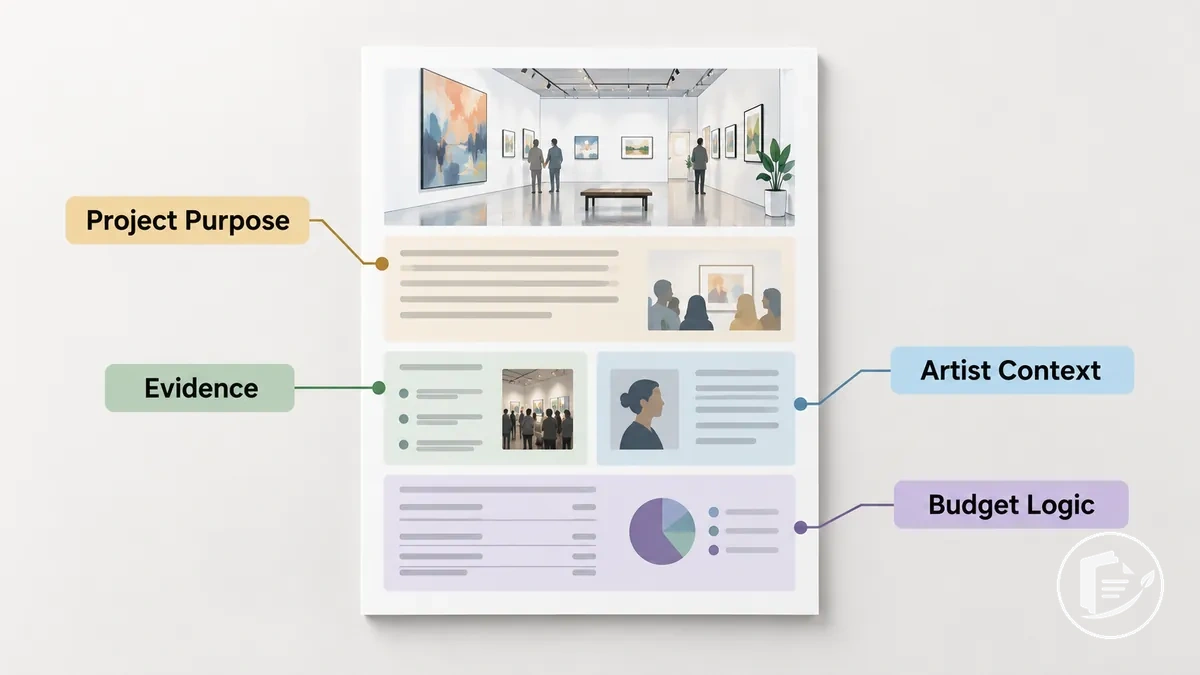
“The project will develop and present a community exhibition exploring local experiences of place through new mixed-media works and participant contributions.”
- Project purpose
- Defines the intended work and public presentation instead of leaving the project as a broad artistic ambition.
- Activities
- Connects creation, community participation, and exhibition within one project scope.
- Outcomes
- Identifies completed works and the proposed exhibition as intended results of the activities.
- Evidence
- Relevant work samples and previous project details support the stated community-based experience.
- Artist context
- Existing mixed-media practice and prior community-based work explain the project’s continuity and fit.
- Budget logic
- Materials, venue use, installation, and presentation costs correspond to activities already described in the proposal.
Together, these links let the application sections describe and support the same project without requiring the reviewer to invent missing connections.
The community exhibition theme, proposed activities, and individual cost categories are context-specific details of this illustrative example.
The transferable relationship is structural: project claims connect to evidence, artist context explains project fit, budget items correspond to activities, and stated outcomes follow from the proposed scope; the wording and particulars require adaptation to the relevant grant program.
Project Narrative: How the Example Establishes Purpose, Activities, and Outcomes
The project narrative establishes a traceable chain from project purpose to activities and intended outcomes.
Its specificity makes the proposed project's scope easier to follow and reduces the amount of information a reviewer must infer.
The project narrative gives the community exhibition a defined purpose: exploring local experiences of place through new mixed-media works and participant contributions.
Its scope connects the artistic work with a public presentation rather than describing only a general intention to make art.
A vague statement such as “create new work for the community” leaves the work and delivery unclear; the more specific example identifies mixed-media work, participant contributions, and an exhibition.
The annotated image makes this purpose-to-activity-to-outcome relationship visible so the narrative sequence can be assessed without relying on prose alone.
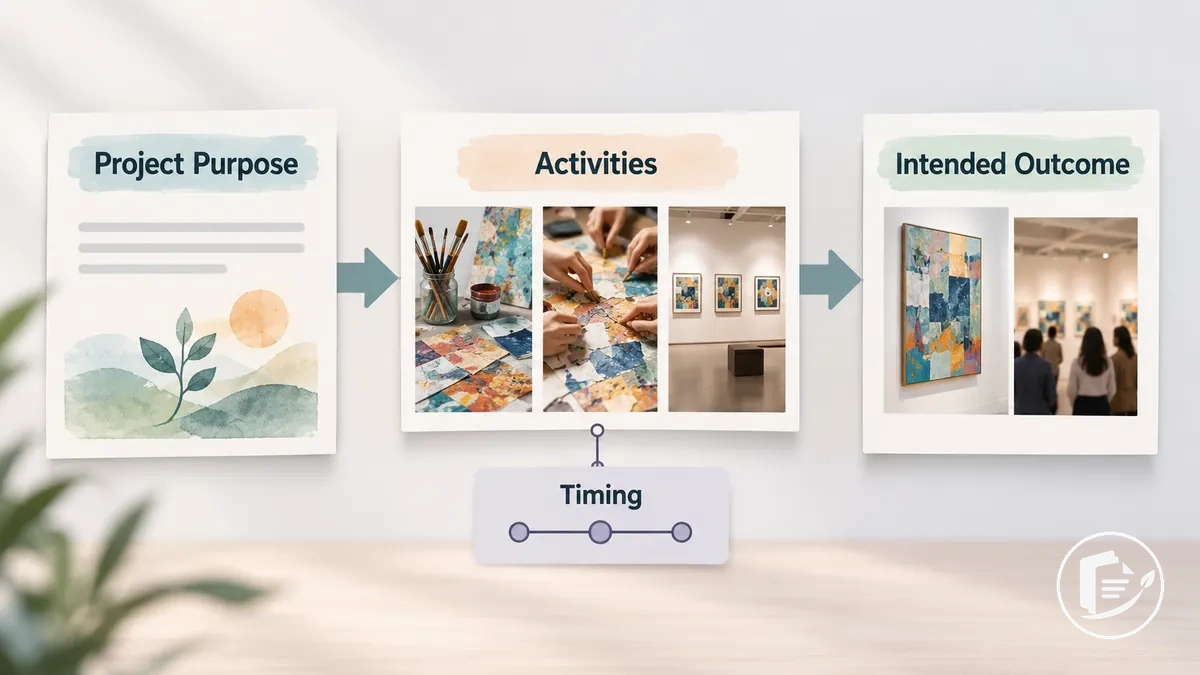
The project narrative also connects activities with the audience, timing, and outcomes that define delivery. Participant numbers and detailed timing remain unspecified in this illustrative example; in a real application, add them when they affect scope, delivery, eligibility, or feasibility, using only confirmed project information.
Keeping unknown figures unspecified avoids false precision while still showing which details would reduce ambiguity about project scale and delivery.
The sequence below organizes the narrative's internal logic and shows where specificity can reduce reviewer inference.
Narrative chain
- Purpose: Make the artistic rationale and project scope explicit.
- Activity: Specify what will happen, who will participate or encounter the work, and the relevant timing.
- Outcome: Identify the intended result that follows from the proposed activities.
This example shows how purpose, activity, and outcome connect without implying that every grant requires the same narrative structure or response format.
For that neighbouring task, art project description examples and structure provide the appropriate boundary for examining project-description construction in more detail.
Artist Context: How the Example Connects Practice to the Proposed Project
Artist context is useful when it explains how the artist’s practice, experience, or artistic concerns relate to the proposed project.
That relevance gives the project rationale continuity and can improve reviewer understanding of why this artist is pursuing this particular work.
The artist’s practice in this illustrative example centres on mixed-media work and prior community-based projects, which is relevant to the proposed community exhibition.
The connection is specific because the proposed project continues both the mixed-media practice and the community-facing context rather than relying on unrelated background information.
The annotated example makes this practice-to-project relationship visible and shows which part of the artist context supplies relevant continuity.

“My mixed-media practice explores experiences of place through collaborative and community-based work; the proposed exhibition develops these artistic concerns through new works and participant contributions.”
Connection: the relevant experience and artistic concerns contextualise the proposed project, while the project extends the same practice into a defined new activity.
This can support an interpretation of project fit and continuity without treating unrelated biography, prestige, or credentials as evidence of proposal strength.
Artist context here remains project-specific rather than becoming a complete account of the artist's background.
A fuller artist statement structure addresses the neighbouring task of organizing artistic practice and background beyond this example-level connection.
Budget Logic: How the Example Connects Costs to the Project Plan
Budget logic is visible when each project cost has a clear function and corresponds to a project activity described in the project plan.
This consistency helps a reviewer assess whether the budget's financial assumptions support the work proposed, while feasibility still depends on scope, timing, grant requirements, and actual resource costs.
The illustrative example links materials expenditure to creating the new mixed-media works described in the proposal.
Because no amount is specified, this example demonstrates cost-to-activity consistency, not whether the allocation is sufficient for the project’s actual scope.
The annotated image clarifies this cost-to-activity alignment without implying a benchmark or appropriate price.

The same logic connects venue and installation costs to presenting the community exhibition, while an unexplained cost with no corresponding project activity creates a mismatch between the budget and narrative.
These two cost-to-activity pairs show the interpretive difference between an explained cost and an unexplained cost.
Their alignment can help demonstrate feasibility, although adequacy still depends on the amounts, project scope, timing, grant rules, and market conditions.
Cost → activity alignment
- Creating mixed-media works: Materials are the related project cost and resource; because no amount is specified, the example demonstrates consistency with the activity but not whether the allocation is adequate for its scope.
- Presenting the exhibition: Venue and installation costs correspond to the presentation activity; this alignment can help demonstrate feasibility when the amounts, timing, and grant rules also support delivery.
This example evaluates cost-to-activity consistency rather than providing a complete budgeting method, market-price guidance, or a universal budget level.
For the neighbouring task of constructing and organizing a complete budget, artist grant budget structure provides the appropriate boundary.
Reviewer Perspective: What Makes the Example Easy to Assess
Reviewer assessability is the ease with which a reviewer can locate a project claim, its supporting evidence, and information relevant to the stated criteria without supplying missing connections.
In this application example, explicit relationships between those elements improve clarity and traceability while reducing the inference needed to understand how the project information supports assessment.
Reviewer traceability test
- ClaimState the material point the reviewer needs to assess, such as relevant community-based experience or a defined project activity.
- EvidencePlace relevant support close to the claim, such as work samples, previous project details, or concrete delivery information.
- Criterion fitMake the relationship to the applicable criterion apparent so the reviewer can assess the information without supplying the connection.
Clear: the claim, supporting evidence, and relevant criterion can be traced directly.
Ambiguous: the same claim appears, but the reviewer must infer which evidence supports it or why it matters to the criterion.
This difference describes information access and inference burden rather than a universal scoring rule. Assessment procedures differ by funder and program, so the published criteria for the current opportunity remain the controlling framework.
Application Coherence: How the Sections Reinforce One Another
Application coherence comes from consistency among sections that describe the same project from different angles.
The project description, budget, artist context, project rationale, activities, and outcomes reinforce the same project logic when their details agree rather than create a mismatch.
The relationships below organize cross-section consistency without repeating the detailed content of each section.
Each pair identifies whether the two application parts align or conflict and the resulting implication for comprehension or credibility.
Cross-section consistency
- Project description ↔ budget — aligned: The description includes creating mixed-media works, while the budget identifies materials as a related project cost. This alignment connects the stated activity with the resource needed to carry it out and can support the application's credibility as a coherent plan.
- Artist context ↔ project rationale — aligned: The artist's mixed-media and community-based experience agrees with the rationale for a community exhibition built around related artistic concerns. The relationship reinforces the relevance of the proposed project without requiring identical wording across sections.
- Activities ↔ outcomes — aligned: Creating new work and presenting a community exhibition correspond to the stated outcomes of completed works and public presentation. This consistency makes the intended progression from activity to outcome easier to comprehend.
- Project description ↔ unexplained budget cost — mismatch: A cost with no corresponding activity in the project description would conflict with the otherwise traceable project logic. Such a mismatch can create ambiguity about the cost's project function and may weaken perceived credibility or feasibility until the relationship is clarified.
How to Extract Reusable Patterns from Successful Grant Examples
Reusable grant-example patterns come from relationships among the prompt or criterion, the applicant's claim, supporting evidence, and application context rather than from copied phrasing.
A successful example can reveal a transferable pattern, but adaptation requires separating that structural relationship from context-specific detail tied to the original applicant, program, or funding cycle.
The sequence below separates structural learning from surface imitation by moving from observation to abstraction and then to a fit test.
Each step preserves the connection between what the example was responding to and what may transfer to another application context.
From example to transferable pattern
- Identify the prompt or criterion: Establish the question, requirement, or assessment criterion that the successful example was addressing so the response is interpreted against its original purpose.
- Identify the response strategy: Determine how the applicant answered that prompt, such as making a project claim explicit or connecting a proposed activity to an intended outcome, without treating the original wording, tone, or length as the strategy itself.
- Trace the evidence: Locate the information that supports the response, such as relevant experience, work samples, project details, or a cost connected to a planned activity. This reveals transferable relationships such as claim-to-evidence, activity-to-outcome, and cost-to-plan.
- Abstract the transferable pattern: Convert the observed relationship into a general principle while excluding context-specific detail. For example, abstract “this applicant used this particular experience” into “a material project claim is connected to evidence relevant to that claim.”
- Test the fit and adapt: Check whether the transferable relationship fits the new prompt, criteria, funding program, and project context before using it. Preserve the underlying logic only where it remains relevant, and adapt the content to the new application's facts.
For a brief worked example, suppose a successful example links a statement about community-based practice to evidence of previous community projects.
The reusable principle is not the original sentence or project history; it is the claim-to-evidence relationship in which relevant evidence supports a material claim.
A different artist can apply that abstraction only when their own evidence supports the claim required by their application context.
Recurring phrasing, tone, length, or structure across successful or high-scoring examples does not by itself establish a universal rule for funding success.
Those features occur within particular prompts, criteria, programs, project contexts, and funding cycles, so the method treats recurrence as an observation to examine rather than proof that the same surface feature will transfer successfully.
Separate Transferable Structure from Grant-Specific Details
Transferable structure is the reusable logic connecting a proposal's clear purpose, evidence, consistency, and criterion alignment, while grant-specific details depend on the particular funder, program, project, discipline, or application form.
A word limit, required field, scoring category, or applicant fact must therefore match the new application context rather than be carried over simply because it appeared in a successful example.
The split below prevents sample-specific constraints from being mistaken for reusable structure.
Each feature is classified by whether its underlying relationship can transfer or whether its expression must be re-derived from the new grant conditions.
Transferable structure vs grant-specific detail
Transferable relationship
- Transferable — clear purpose and criterion alignment: The relationship can transfer because a proposal can make its purpose explicit and connect that purpose to the relevant criterion, although the actual purpose and criterion depend on the new opportunity.
- Transferable — claim and evidence: Connecting a material claim to relevant evidence is reusable logic, while the claim, evidence, and form of support remain specific to the applicant and project.
- Transferable — consistency: Agreement among related project details can transfer as a structural principle, but which details require alignment depends on the application context.
Grant-specific input
- Grant-specific — word limit and required field: These constraints belong to the relevant application form or program and must match its stated requirements rather than those of the example.
- Grant-specific — scoring category: The category remains tied to the assessment framework of the relevant opportunity, so adaptation must follow the criteria actually used for that grant.
- Grant-specific — applicant fact: An artist's experience, discipline, project detail, or other factual information remains specific to that applicant and cannot be transferred as proposal content.
For example, one grant may provide a dedicated required field for project purpose, while another may require the same purpose to be expressed within a broader response to a criterion.
The transferable principle is to make the project's purpose clear and relevant to the applicable criterion; its placement and expression change with the grant-specific constraint.
Identify the Evidence Behind Strong Claims
A grant claim is easier for a reviewer to assess when the application supplies concrete, relevant evidence rather than leaving the claim as an assertion.
The supporting detail or observable basis should relate to the applicable criterion and provide a basis for interpreting the claim's relevance, feasibility, or intended impact.
The criteria below distinguish assertion from relevant substantiation by pairing each claim type with an evidence signal and its assessment implication.
The presence of more detail does not necessarily strengthen a claim when that detail is unrelated to the criterion.
Claim → evidence → assessment implication
- Experience claim → relevant prior work: Specific previous projects, work samples, or documented experience can support a claim about relevant practice by giving the reviewer an observable basis for assessing relevance.
- Activity claim → concrete project detail: Supporting detail about the proposed activity, participants, timing, or delivery context can substantiate what the project involves and improve clarity without requiring unsupported assumptions.
- Feasibility claim → resource and timing connection: Evidence that identified resources, costs, or timing correspond to planned activities can provide a basis for assessing feasibility, although adequacy depends on the project's actual scope and grant conditions.
- Impact claim → defined intended outcome: A stated intended outcome connected to the proposed activity can make the expected impact more assessable, but it does not confirm that the outcome will occur without evidence of actual results.
A weak claim such as “I have strong experience working with communities” remains largely an assertion when no relevant support is attached; a supported version identifies applicable previous community-based work or a corresponding work sample as evidence for that claim.
The second version is more assessable because the reviewer can trace the claim to relevant support, while the strength of that support still depends on its relevance to the criterion being assessed.
How to Adapt Example Patterns to Your Own Artist Grant Application
Adaptation means preserving a useful relationship from an example pattern while replacing the original applicant's facts, wording, and constraints with your own project-specific evidence and grant conditions.
The current grant prompt, criteria, required field, and project context remain the controlling inputs.
The sequence below uses the example as a structural reference rather than a text source.
Each step transfers the relationship only after checking that it fits the current opportunity.
Adaptation sequence
- Identify the current grant prompt and criteria: Establish exactly what the required field asks and which criteria the response must address before selecting any example pattern.
- Select a relevant example pattern: Choose a transferable relationship that matches the current need, such as claim-to-evidence, activity-to-outcome, or cost-to-plan, rather than relying on the source wording.
- Substitute project-specific evidence: Replace the original applicant's facts with your own project details, experience, resources, outcomes, and evidence so the adapted relationship reflects your application context.
- Check cross-section consistency: Confirm that the adapted response agrees with the budget, artist context, activities, outcomes, and other application sections that describe the same project.
- Verify fit with the current opportunity: Recheck the response against the grant prompt, criteria, required field, and grant conditions. If the adapted relationship no longer answers the current opportunity, revise or discard it.
For example, an original application might connect prior community-based practice to a proposed community exhibition.
An adapted version for a different artist could connect prior site-specific sculpture work to a proposed public installation, retaining the relationship between relevant experience and project rationale while changing the subject matter, evidence, and wording.
The example pattern remains useful only if that relationship is relevant to the new prompt and criteria.
Final verification means checking that the adaptation still answers the current grant, uses accurate project-specific evidence, and remains consistent with the rest of the application.
Expanding beyond this adaptation task into complete proposal construction belongs under how to write an art grant proposal.
Rebuild the Example Logic Around Your Own Project
Rebuilding the example logic means replacing sample-specific content with truthful project facts, constraints, goals, activities, and evidence while retaining only the relevant project claim-to-evidence and activity-to-intended-result relationships.
Facts, numbers, timing, claims, and supporting details must come from your own application and remain relevant to the current grant.
The sequence below reconstructs the chosen relationship around your own project-specific logic rather than the sample's nouns, chronology, or claims.
Each step uses information you can verify from your project.
Rebuild with verified project facts
- State the actual project claim: State what your project is proposing or claiming, using project facts and goals that accurately describe the work within its real constraints.
- Identify the available evidence: Identify the supporting details that are relevant to the project claim, such as existing work, confirmed resources, or other evidence actually available to your application; leave an unknown detail unspecified rather than inventing it.
- Connect the activity to the intended result: Show how the proposed activities relate to the intended result, using truthful project-specific information about what will happen and what those activities are intended to produce.
- Check consistency across the application: Verify that facts, numbers, timing, activities, evidence, and intended results agree wherever they appear in the application and match the conditions of the current grant.
For a narrow scenario, suppose your actual project involves producing new work for a public presentation and you have relevant prior work available as evidence; rebuild the relationship by connecting that evidence to the specific project claim and the planned activity to its intended result.
Use only facts you can verify from your own project, and leave any unknown number, date, timing detail, or evidence unspecified until it can be confirmed.
Adapt Relationships Between Sections Instead of Copying Wording
Relationships between application sections are more transferable than the original wording because the logical connection can remain relevant while project-specific expression changes.
The project facts and grant context should determine the wording, rather than the tone, phrasing, personal history, or claims of the original applicant.
The paired relationships below organize the logical connections that should remain consistent when project information is substituted.
The relationship is the structural reference; its specific facts and expression may change with the current grant context.
Relationships to preserve
- Project need ↔ activity: The proposed activity should respond logically to the stated project need. The particular need, activity, emphasis, and wording may change to reflect the artist's own project and the grant context.
- Activity ↔ outcome: The intended outcome should follow logically from the activity described in the application. The activity details, intended result, scale, timing, and expression may change when the underlying project changes.
- Project plan ↔ budget: The budget should align with the activities and resources described in the project plan so that relevant costs have a clear project function. Individual costs, amounts, categories, and wording may change according to the project's actual requirements and grant conditions.
- Artist context ↔ rationale: The artist context should remain relevant to the rationale for the proposed project. The experience, artistic concerns, project facts, and wording may change because they should reflect the current applicant rather than the original applicant's personal history.
As a consistency check, the adapted application should describe one project coherently from several required angles, with each section supporting rather than contradicting related information elsewhere.
If the sections depend on borrowed formulations that do not reflect the same project facts, the cross-section relationship should be revised to match the applicant's own information.